
 English (UK)
  Türkçe
  العربية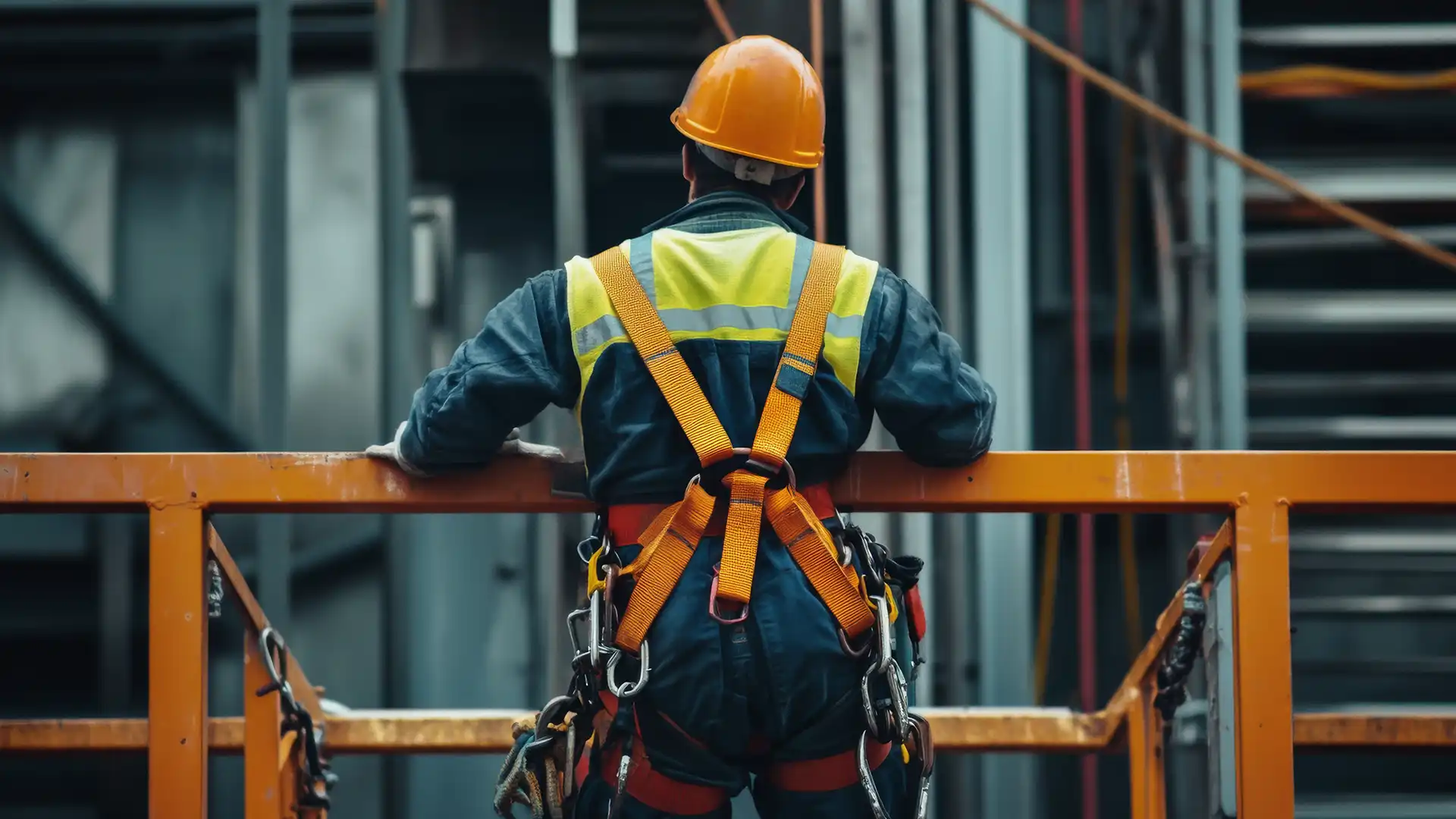
A work at height helmet is a special head protector designed to stay on the head even during a fall, with a strong chin strap and multi-directional impact protection. Its fundamental difference from the classic industrial hard hat (EN 397) used in ground-level work is this: an ordinary hard hat only protects the top against objects falling from above, and its chin strap breaks away at low force against the risk of snagging; a work at height helmet (EN 12492) protects against impacts to the side, front, and back during a fall, and its chin strap holds firmly so the helmet does not come off the head. This is why choosing the right helmet in work at height is directly a matter of life safety.
Are a Hard Hat and a Work at Height Helmet the Same Thing?
Although all of them are called “helmets” in everyday language, technically there are two different products and two different standards. The distinction arises from the usage scenario: does the danger come from above, or is the person themselves falling?
An industrial hard hat is basically designed to protect the top of the head against objects falling from above. A work at height helmet, on the other hand, centers on the possibility of the person falling: during a fall, the helmet must stay on the head and protect not only the top but also the surroundings. These two different priorities give rise to two different standards.
What Is the Difference Between EN 397 and EN 12492?
The heart of helmet selection in work at height lies in the difference between these two standards.
EN 397 — Industrial Hard Hat
This is the standard for general industrial head protection. Its primary purpose is to protect against objects falling from above; impact absorption tests focus mainly on the top point of the helmet. It has a critical feature: in EN 397 hard hats, the chin strap is designed to break away at a low force (approximately 150-250 N). The reason for this is to prevent the user from being strangled if the hard hat snags on something. So this hard hat makes sense for someone working on the ground; but for someone falling from height, the helmet may come off the head.
EN 12492 — Work at Height and Mountaineering Helmet
Initially developed for mountaineering, this is the norm that has today become the standard for work at height and rescue operations. It has two fundamental differences: First, impact protection is not limited to the top; it also covers impacts to the side, front, and back. Second, and most critically, the chin strap is designed to withstand a high force (at least 500 N); that is, during a fall, the helmet does not come off the head but stays in place. This is exactly the difference that saves lives in work at height.
Why Is EN 12492 Needed in Work at Height?
The logic is simple: When a person working at height falls, the fall arrest system holds them in the air; but during this, the head may strike the structure or surrounding obstacles. This impact comes not from the top, but often from the side or front. An EN 397 hard hat is not tested against such impacts and, more importantly, may come off the head at the very moment it is needed because of the low-force break-away chin strap.
An EN 12492 helmet, on the other hand, both meets multi-directional impact and stays on the head with a strong chin strap. This is why an EN 12492 certified helmet should be preferred in work at height environments such as towers, poles, scaffolding, and roofs.
Additional Standards for Electrical and Other Special Risks
Some work environments require additional features beyond basic impact protection. There are complementary standards that come into play in these cases:
- EN 50365 — Electrical insulation: Defines electrically insulating helmets for use in low-voltage installations (usually 1000 V AC / 1500 V DC class). Helmets with ventilation holes are generally not preferred in electrical work, because the integrity of the shell must be preserved.
- EN 14052 — High-performance industrial helmet: Provides increased side impact protection; preferred in heavy industry scenarios.
- EN 397 optional markings: The same hard hat may also have passed additional tests such as low/high temperature, 440 V AC electrical, lateral deformation (LD), or molten metal splash (MM). These codes are marked on the hard hat.
The right choice is made according to the risk of the work environment: in a high and electrified environment, both EN 12492 and electrical insulation must be evaluated together.
How to Choose the Right Work at Height Helmet?
When choosing a helmet, the following criteria must be evaluated together:
- Standard: EN 12492 for work at height; EN 397 for ground work.
- Chin strap behavior: A firmly holding (non-breaking) chin strap in work at height; a break-away strap in ground work with snagging risk.
- Electrical risk: EN 50365 insulating in live environments, or at least an EN 397 “440 V AC” marked, non-ventilated shell.
- Comfort and ergonomics: Ratchet adjustment, inner suspension, sweatband, and balanced weight reduce fatigue in long shifts.
- Accessory compatibility: Models to which earmuffs, visor/face shield, and headlamp can be attached provide versatile use.
The service life of a helmet varies according to the manufacturer, material, and UV exposure. A helmet that has taken an impact or is cracked must be replaced, even if it appears intact.
The Helmet Is Also Part of the System
Work at height safety is the result not of individual pieces of equipment, but of a system compatible with one another. As much as the harness, lanyard, anchor, and fall arrest device, a correctly chosen helmet is also an inseparable part of this system. The wrong helmet can leave the head unprotected even if the rest of the system is flawless.
EKS Work Safety’s helmets, harnesses, lanyards and energy absorbers, anchors, and connection equipment are evaluated as a system to provide holistic protection from head to toe in work at height.
Frequently Asked Questions
Can a normal hard hat be used in work at height?
It is not recommended. A normal industrial hard hat (EN 397) only protects the top against objects falling from above, and its chin strap breaks away at low force. In work at height, an EN 12492 certified helmet should be preferred so that the helmet stays on the head during a fall.
What is the basic difference between EN 397 and EN 12492?
The EN 397 industrial hard hat focuses on top impact and its chin strap breaks away at low force against the strangulation risk. The EN 12492 helmet meets multi-directional impact and prioritizes staying on the head during a fall with a strong chin strap.
Which helmet should be used in electrical work?
In live environments, electrically insulating EN 50365 helmets or at least EN 397 “440 V AC” marked models without ventilation holes should be preferred.
When should a helmet be replaced?
Any helmet that has taken an impact, is cracked, or is deformed must be replaced, even if it appears intact. In addition, the service life stated by the manufacturer and UV aging must be taken into account.
The Right Helmet, with the Right System, Saves Lives
The work at height helmet is one of the most visible but most underestimated parts of safety. The difference between a ground-level hard hat and a work at height helmet — the behavior of the chin strap and multi-directional impact protection — can determine life during a fall. This is why helmet selection must be made according to the height and risk of the work.
With over 20 years of experience, EKS Work Safety provides work at height helmets and all head protection equipment within a system compliant with the relevant standards. For a standards-compliant helmet and safety system suited to your work area, you can contact EKS Work Safety.
Visit our LinkedIn page to learn more.

 by
by