
 English (UK)
  Türkçe
  العربية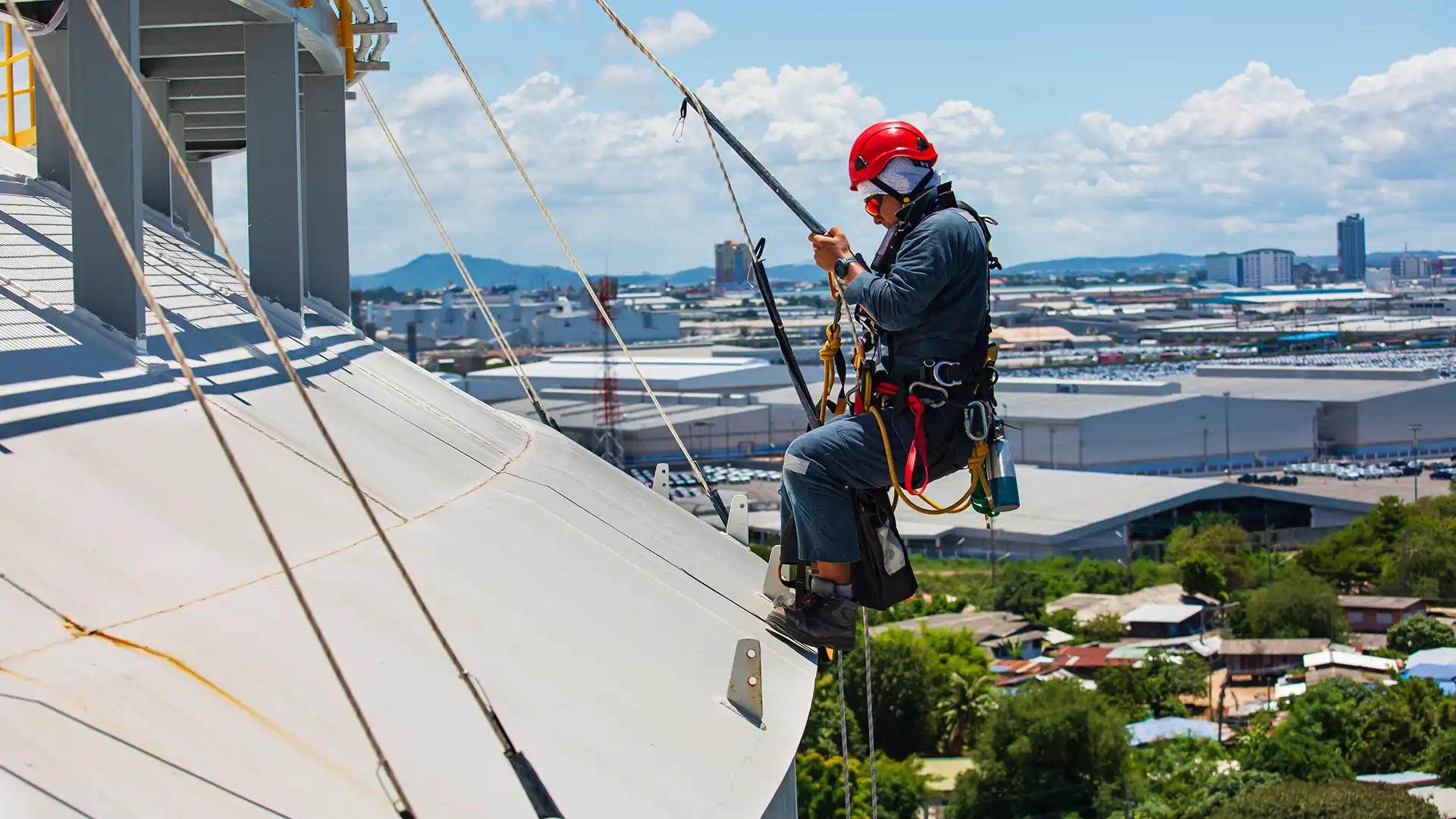
Rope access is a work at height method developed from mountaineering and caving techniques, providing safe, fast, and economical work on tall or hard-to-reach structures using ropes and equipment. It is also known as industrial climbing. At the foundation of its safety lies the twin rope principle: the technician is always attached to two independent lines — one the working line that carries the weight, the other the backup safety line that engages in case of a problem. In places where erecting scaffolding is difficult or expensive, such as facades, towers, bridges, wind turbines, and refineries, rope access with trained technicians and equipment compliant with standards such as EN 12841 is considered one of the safest alternatives.
What Is Rope Access?
Rope access is an access technique that makes it possible to work at points that are risky, expensive, or time-consuming to reach by traditional methods (scaffolding, platform, crane basket). Its origin lies in mountaineering and caving techniques; these techniques have become a safe profession by being adapted to the industrial workflow.
The main advantage of the method is speed and flexibility: a facade job that takes days with scaffolding can be completed in a much shorter time and at less cost with rope access. However, this speed does not require compromising on safety; on the contrary, rope access is based on a strict safety discipline.
The Twin Rope Principle: The Foundation of Safety
The heart of the safety logic of rope access is the twin rope (two-line) principle. This principle is based on the logic that “the failure of a single point must never be fatal.”
Each technician works attached to two independent lines at the same time:
- Working line: The main rope that carries the technician’s weight, on which the descent or ascent device is located. Normal work is carried out on this line.
- Backup safety line: An independent second rope attached to a separate anchor. On it is a safety device (rope grab / fall arrester) that stops the fall in case of a problem on the working line.
These two lines are independent of each other and are attached to separate anchor points. Thus, even if there is an unexpected problem on the working line, the backup safety line holds the technician. This “redundant” structure is the fundamental element that makes rope access one of the safest work at height methods.
Basic Equipment Used in Rope Access
Rope access safety is based on a system of mutually compatible equipment. The basic components are:
- Full body harness: The main equipment that distributes the technician’s load in a balanced way and provides all connection points.
- Working and safety ropes: Usually low-stretch (static) kernmantel ropes; one for the working line, one for the backup line.
- Descender: A device with a braking mechanism that enables controlled descent on the working line.
- Ascender: A device that enables climbing up on the rope and locks in one direction.
- Backup fall arrester: A device that moves on the safety line and locks during a fall.
- Carabiners and connection elements: Connectors that safely link all components to one another.
- Helmet and other PPE: Head protection and task-specific additional equipment.
Rope access equipment is usually subject to standards such as EN 12841 (rope adjustment devices for rope access systems) and requires regular inspection and record-keeping (EN 365).
Where Is Rope Access Used?
Rope access can be preferred in almost any work at height scenario where erecting scaffolding is difficult, expensive, or impractical:
- Cleaning, painting, and insulation on skyscraper, plaza, and tower facades
- Maintenance and inspection on bridge, viaduct, and dam structures
- Maintenance on wind turbine towers and blades
- Work at height maintenance-repair in refineries, petrochemical plants, and power stations
- Work on telecommunications and energy towers
- Inspection on industrial tank and chimney structures
The common point in all of these is that the work requires tiered training and competence. Rope access technicians are trained according to internationally recognized tiered training and certification systems; there are usually levels such as technician, advanced technician, and supervisor.
Why Is Rope Access Considered Safe?
The safety of rope access comes not from a single piece of equipment, but from a whole set of disciplines:
- Twin rope: The independent backup line compensates for a single-point failure.
- Trained team: Technicians receive tiered training; teams of at least two people work, and each team has rescue capability.
- Certified equipment: All equipment is compliant with EN and CE standards, regularly inspected, and recorded.
- Rescue readiness: In a possible emergency, a technician within the team is trained to quickly rescue the other.
When these elements come together, rope access becomes one of both the fastest and safest methods of work at height. However, this safety is valid only when the right equipment, the right training, and the right procedure are applied together.
Frequently Asked Questions
Are rope access and industrial climbing the same thing?
Yes, both refer to the same method. “Rope access” is the term in international literature; in Türkiye, the same method is also known as “industrial climbing.” However, technically it is a profession different from sport mountaineering, with its own standards and certification.
Why is the twin rope system used?
To double the safety. While a working line carries the technician’s weight, a separate and independent backup safety line stops the fall in case of a possible problem. Thus, the failure of a single point is not fatal.
Which standards is rope access subject to?
Rope access equipment is subject to standards such as EN 12841 (rope adjustment devices) and requires regular inspection and record-keeping under EN 365. Technicians are certified according to internationally recognized tiered training systems.
Is rope access faster than scaffolding?
Usually yes. Because it does not require the erection and dismantling of scaffolding, rope access can be much faster and more economical, especially on tall facades and hard-to-reach structures; however, its suitability for each job must be evaluated separately.
Speed and Safety Meet on the Same Rope
Rope access is a powerful method that brings together speed, flexibility, and safety in work at height. The secret of its strength is not in a single product; it is in a holistic system consisting of the twin rope principle, mutually compatible certified equipment, tiered training, and rescue readiness. A correctly set up rope access system makes it possible to safely reach places that scaffolding cannot.
With over 20 years of experience, EKS Work Safety provides harnesses, ropes, carabiners, pulleys, rope grabs, and climbing equipment for rope access within a safe, unified system. For standards-compliant rope access equipment suited to your work area and task, you can contact EKS Work Safety.
Visit our LinkedIn page to learn more.

 by
by