
 English (UK)
  Türkçe
  العربية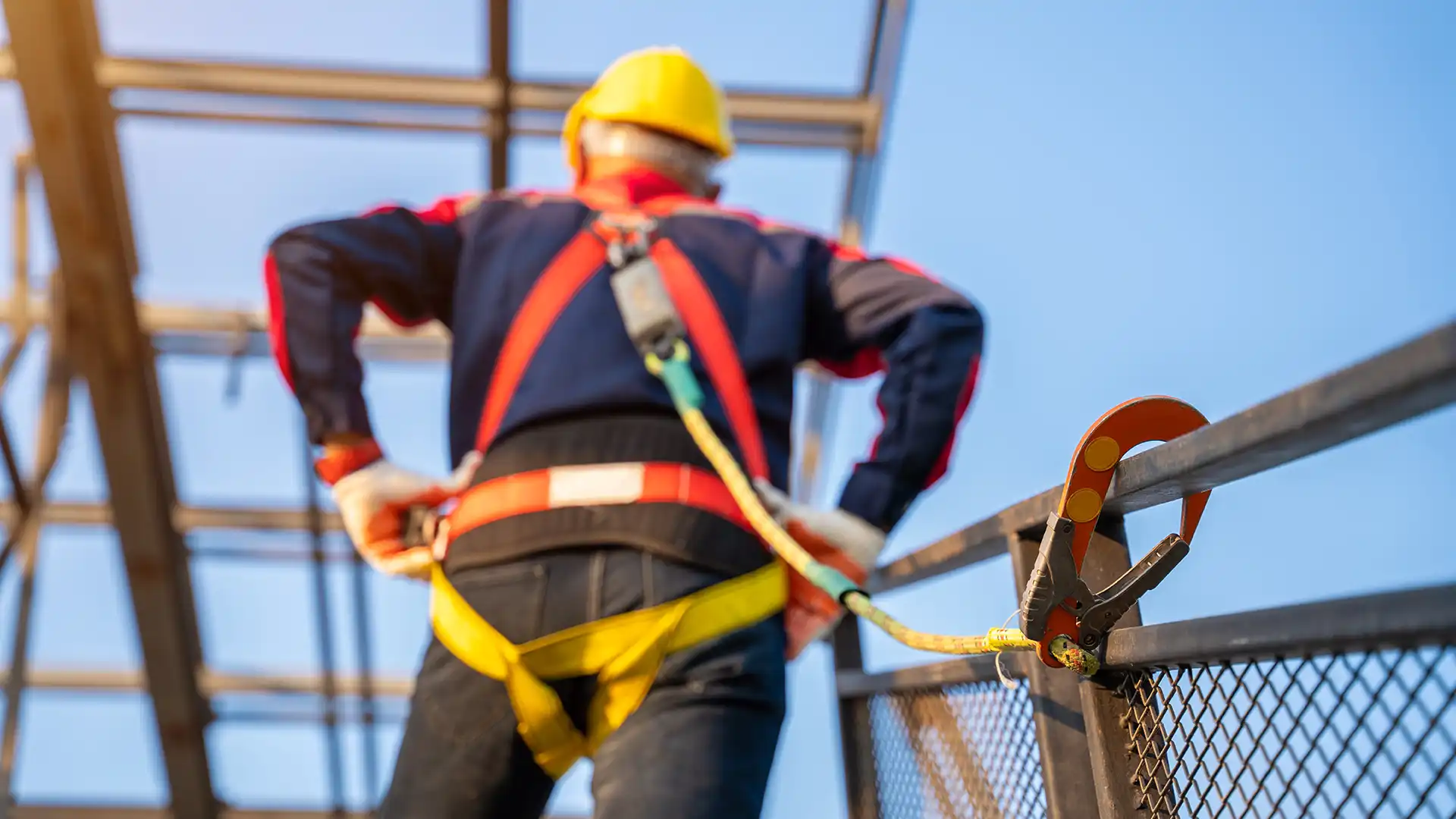
Safety in working at height depends not on the strength of a single piece of equipment, but on how equipment works together and correctly. The three most commonly used components on site—retractable fall arresters, lanyards, and safety harnesses—form a complementary safety chain. If any link in this chain is selected incorrectly or used improperly, the overall system performance can drop significantly.
For this reason, fall arrest systems should be considered not as individual products, but as an integrated structure.
Why Is a Holistic Approach Important in Fall Arrest Systems?
During a fall, the force acting on the body does not depend solely on the device that stops the fall. How the force is distributed, how quickly it is absorbed, and where it is transferred to the body are decisive factors.
At this point:
- The retractable fall arrester,
- The lanyard or energy-absorbing lanyard,
- The safety harness and carabiners,
must work in harmony within the same system. Otherwise, a product combination that is theoretically correct may fail to deliver the expected protection on site.
The Safety Harness Is the Foundation of the System
The safety harness is the primary component of fall arrest systems that comes into direct contact with the body. In particular, full body harnesses are designed to distribute the force generated during a fall across the entire body.
The role of the safety harness within the system:
- Prevents fall forces from concentrating on a single point,
- Balances load distribution through shoulder, waist, and leg connections,
- Ensures controlled transfer of force coming from the retractable fall arrester.
An unsuitable safety harness can limit the performance of even the most advanced retractable fall arrester.
Where Does the Lanyard Fit into the System?
A lanyard is a flexible element that creates a connection between the safety harness and the anchor point. It is frequently preferred in fixed or semi-fixed work areas where movement is limited.
However, a lanyard:
- Has a fixed length,
- Can create slack in the line,
- May be disadvantageous in scenarios requiring an immediate stop.
For this reason, a lanyard does not serve the same function as a retractable fall arrester; it provides different solutions for different risk levels.
How Does an Energy-Absorbing Lanyard Contribute to the System?
An energy-absorbing lanyard includes an energy absorber mechanism in addition to a standard lanyard. This mechanism reduces the force transmitted to the body by dissipating the kinetic energy generated during a fall.
An energy-absorbing lanyard:
- Provides energy absorption,
- Softens the stopping motion,
- Balances the load acting on the safety harness.
However, because it requires an extension distance to deploy, it may not always be the ideal solution in confined areas or where obstacles exist at lower levels.
Retractable Fall Arrester: The Dynamic Component of the System
A retractable fall arrester automatically adapts to the user’s movement. During normal operation, it allows the line to extend freely; when sudden acceleration is detected, it locks within milliseconds.
Key features of this system:
- Does not create line slack,
- Stops a fall within a very short distance,
- Makes sudden stops controlled,
- Ensures continuity in dynamic work environments.
For this reason, the retractable fall arrester plays a critical role within fall arrest systems, especially in dynamic and high-risk sites.
How Do These Three Components Work Together?
When used together, the system operates as follows:
- The safety harness distributes fall forces evenly across the body.
- The carabiner provides a secure connection between the safety harness and the retractable fall arrester or lanyard.
- The retractable fall arrester detects the fall instantly and stops it over a short distance.
- In required scenarios, the lanyard or energy-absorbing lanyard supports access and transition needs within the system.
Thanks to this structure, fall arrest systems do not merely stop a fall—they manage its impact.
Why Do Incorrect Combinations Create Risk?
Even when each piece of equipment is correct on its own, incorrect combinations can create serious risks.
Common mistakes observed on site:
- Adding unnecessarily long lanyards to a retractable fall arrester,
- Failing to account for the deployment distance of an energy-absorbing lanyard,
- Using unsuitable carabiners,
- Selecting incorrect attachment points on the safety harness.
Such practices can eliminate the system’s rapid-response advantage.
Which Combination Is Right for Which Scenario?
There is no single correct solution for every worksite. The right combination must be determined through risk assessment.
- Fixed and low-risk areas: Lanyard + safety harness
- Areas requiring energy absorption: Energy-absorbing lanyard + safety harness
- Dynamic and high-risk sites: Retractable fall arrester + safety harness
- Applications requiring transitions: Retractable fall arrester + short lanyard combinations
This approach makes safety systematic rather than incidental.
EKS Work Safety’s Approach
EKS Work Safety considers retractable fall arrester solutions not as standalone products, but as integrated systems that work together with lanyards, energy-absorbing lanyards, safety harnesses, and carabiners.
With this approach:
- System compatibility is increased,
- Site-specific combinations are created,
- Performance losses are minimized,
- Safety becomes sustainable.
Safety Is Achieved Through the Right System, Not a Single Product
In working at height, safety is ensured not merely by using equipment, but by using the right equipment in the right combination. Retractable fall arresters, lanyards, and safety harnesses are not alternatives to one another; they are system components that gain meaning when used together.
To identify the most suitable fall arrest systems for your worksite, design proper safety harness and carabiner compatibility, and keep safety under control, you can contact us.
Visit our LinkedIn page to learn more.

 by
by