
 English (UK)
  Türkçe
  العربية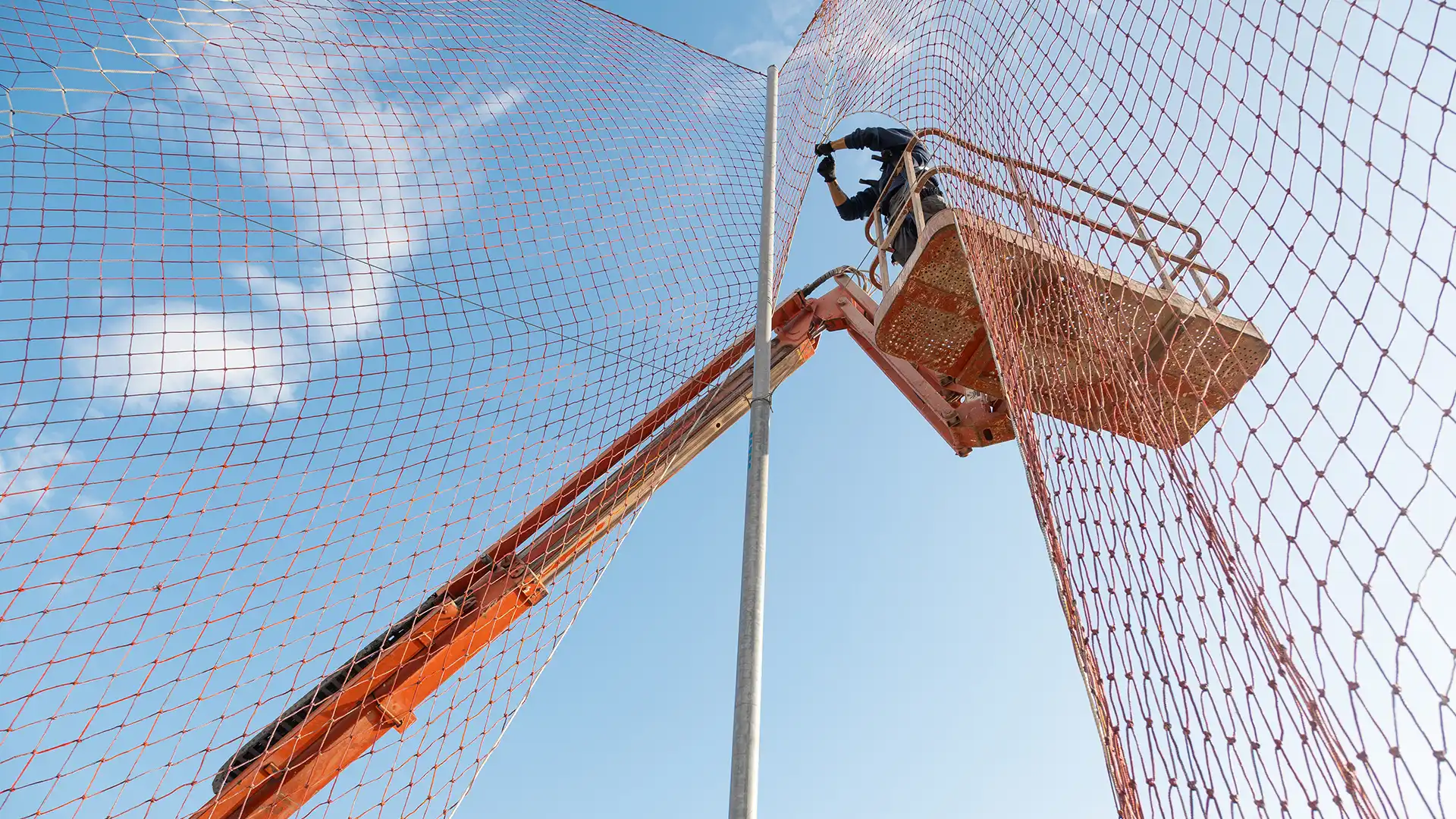
A safety net is a collective protection system designed to catch a person or object falling from height, protecting everyone on site independently of worker error. Unlike an individual piece of equipment such as a harness, a safety net does not depend on the correct behavior of a single worker; it protects the entire work area at once. This is why, in the protection hierarchy of occupational health and safety legislation, collective protection measures such as safety nets come before personal protective equipment. Safety nets are manufactured and installed according to the EN 1263 standard; the right type and correct installation determine whether the net truly saves lives.
What Is a Safety Net and How Does It Work?
A safety net is a passive protection system tensioned with a border rope and support elements, designed to catch people or materials falling from height. Being “passive” means it does not require the worker to actively use it: once the net is installed, it catches the worker even if they fall while doing their normal job.
The net absorbs the energy of the falling person by stretching and limits the fall distance. For this to be safe, two conditions are critical: the net must be installed as close as possible to the work platform (to reduce the fall height), and there must be sufficient clear distance beneath the net so that the person does not hit a surface during the stretch.
Why Does Collective Protection Come Before Individual Protection?
Legislation establishes a strict order of priority against fall risks: collective protection first, then individual protection. The basic principle of this is simple: collective protection measures protect all workers at risk at the same time and do not depend on the correct behavior of a single person.
A harness provides protection only when it is put on correctly and attached to the correct anchor; that is, it depends on the correct behavior of the individual. A safety net, on the other hand, protects everyone on site, no matter what anyone does. This is exactly why a safety net — because it is independent of worker error — is at the forefront of collective protection measures.
Safety Net Types: S, T, U, and V
Safety nets are divided into four main system types under EN 1263 according to their manner of use and installation. The right type is chosen according to the fall scenario and the structure of the work area.
- Type S: Horizontal nets tensioned with a border rope. Installed beneath openings such as elevator shafts, shafts, and gallery openings.
- Type T: Systems used horizontally by being attached to brackets (consoles). Common in facade work and at the edges of floor slabs; cassette system safety nets are also within this scope.
- Type U: Nets used on vertical surfaces by being attached to a support structure.
- Type V: Systems attached to console poles (suspension poles), usually providing vertical protection at the building edge.
Nets can also be knotted or knotless according to their mesh structure. Knotless nets reduce the risk of facial injury to a worker falling onto them and do not suffer the tightening problem that develops over time.
What Does the EN 1263 Standard Mean?
The safety of safety nets is guaranteed by two complementary standards:
- EN 1263-1: Determines the net’s material (usually polypropylene or polyamide fiber), performance criteria, and test methods. According to this standard, a safety net must typically be able to catch a 100 kg weight falling from a height of 7 meters and must not break.
- EN 1263-2: Relates to installation and layout; defines system types, anchor spacings, and installation conditions. According to this standard, the maximum permitted fall height is 6 meters (approximately 7 meters nominal fall height when the worker’s center of gravity is taken into account).
It is essential that a safety net complies with the standard in terms of both material (EN 1263-1) and installation (EN 1263-2). It is not enough to just buy a quality net; an incorrectly installed net does not provide the expected protection.
Critical Points in Safety Net Installation
Whether the net actually provides protection depends on its correct installation. The basic elements to pay attention to in the field:
- Limiting the fall height: The net must be installed as close as possible to the work platform; the fall height must be kept below the limit specified in the standard.
- Clear distance beneath it: Sufficient space must be left so that the person does not hit an object below or the ground when the net stretches.
- Joining nets: If nets are to be joined together, a standard-compliant connection (coupling) rope must be used; weak areas such as corner transitions must be specially reinforced.
- Anchor and support structure: The consoles and connection elements carrying the net must also be standard-compliant and solid.
- Regular inspection: The net must be inspected after UV aging, damage, or a fall event; a net found to be non-compliant must be replaced.
The common message of these points is this: a safety net is not a product, but a correctly installed system. Even if the net itself complies with the standard, incorrect installation can eliminate the protection.
The Safety Net Is Part of the System
Collective protection is the first line of defense in work at height safety; but it is not sufficient on its own. A safety net forms a layered safety system together with individual protection equipment such as a harness, lifeline, anchor, and fall arrest device. Collective protection protects everyone, while individual protection provides additional assurance in special situations.
EKS Work Safety’s safety nets, harnesses, lifelines, anchors, and connection equipment are evaluated as a holistic system covering both collective and individual protection.
Frequently Asked Questions
What is the difference between a safety net and a harness?
A safety net provides collective protection; it protects everyone on site independently of worker error. A harness is individual protection and works only when put on correctly and attached to the correct anchor. In legislation, collective protection comes before individual protection.
Which standard are safety nets manufactured to?
Safety nets are manufactured and installed according to EN 1263-1 (material, performance, test) and EN 1263-2 (installation, layout) standards. Compliance with both standards is essential.
What is the difference between a Type S and Type T safety net?
Type S is a horizontal net tensioned with a border rope and installed beneath openings such as elevator shafts, shafts, and galleries. Type T is a system used by being attached to brackets, common on facades and floor slab edges.
Why is clearance needed beneath a safety net?
The net absorbs the energy of the falling person by stretching. During this stretch, there must be sufficient clear distance beneath the net so that the person does not hit a surface below.
The Right Net, with the Right Installation, Protects Everyone
The safety net is the most concrete and effective tool of collective protection in work at height. Being the field equivalent of the “collective protection first” principle, a safety net — when the right type is chosen and it is installed in compliance with the EN 1263 standard — protects everyone on site independently of worker error. This is why a safety net does not replace individual protection equipment; it is the first line of defense that comes before them.
With over 20 years of experience, EKS Work Safety provides safety nets and all work at height equipment within a unified system covering collective and individual protection. To set up a standards-compliant safety system suited to your work area, you can contact EKS Work Safety.
Visit our LinkedIn page to learn more.

 by
by