
 English (UK)
  Türkçe
  العربية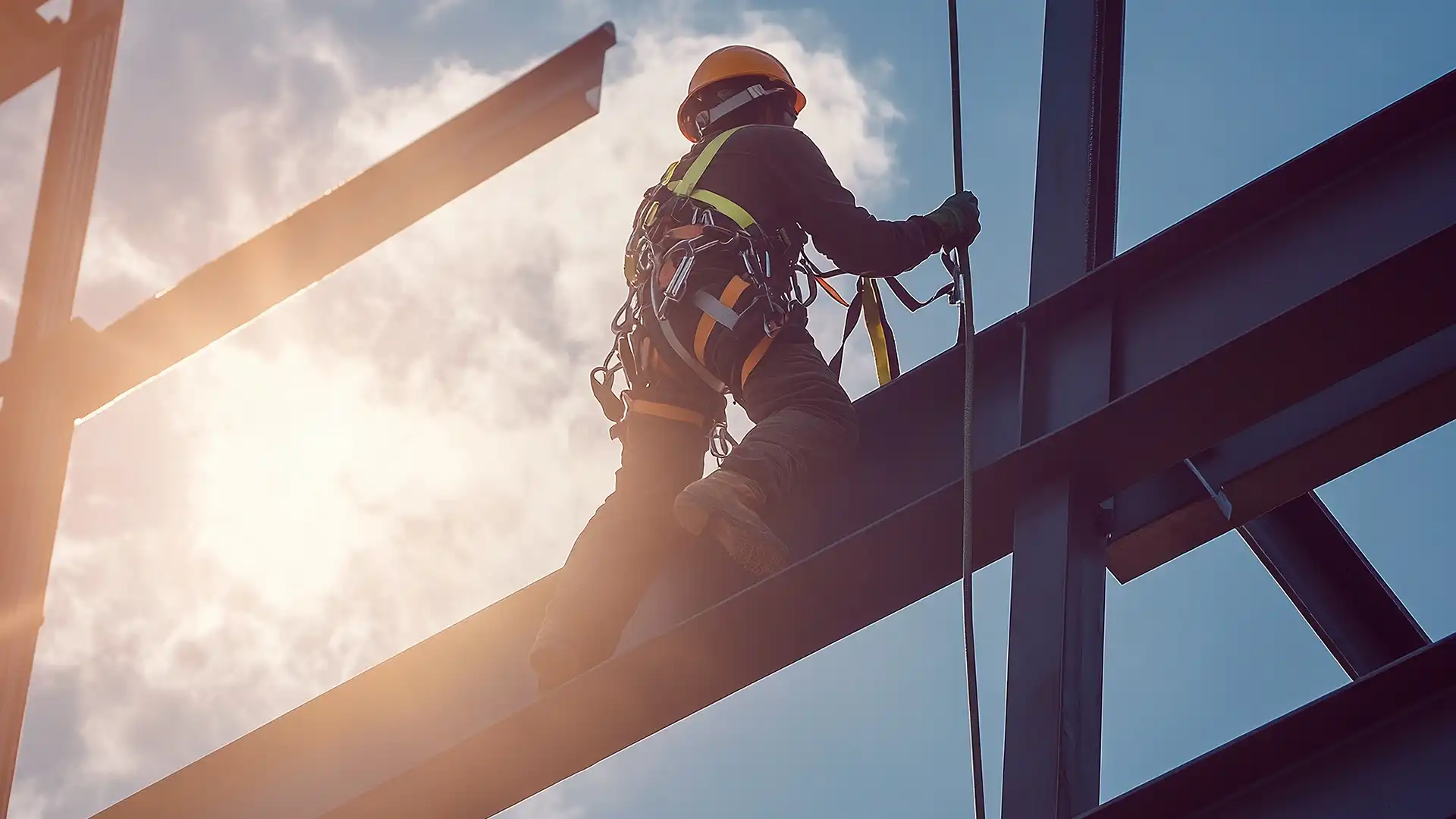
Working at height safety is not a process achieved solely through the use of equipment. When most workplace accidents in the field are analyzed, it becomes clear that risks are often caused not by a single factor, but by a combination of human errors and system deficiencies. For this reason, creating sustainable safety requires evaluating not only employee behavior, but the entire safety system as a whole.
EKS Work Safety approaches working at height safety not only from an equipment perspective, but also through system planning, connection safety, and real field scenarios.
Is Human Error Really the Biggest Risk?
In many workplace accidents, the first factor that draws attention is human error. However, behind employee-related mistakes, there are often underlying system deficiencies.
The most common human-related issues include:
- Connecting the harness to the wrong attachment point
- Choosing a lanyard length unsuitable for the working area
- Failing to check the carabiner locking mechanism
- Connecting Retractable Fall Arrest systems to incorrect anchor points
- Skipping safety procedures due to time pressure
Although these mistakes may appear to be directly caused by employees, they are often related to inadequate training, incorrect system design, or improper equipment planning.
In working at height safety processes, it is just as critical for the system to guide the worker correctly as it is to control human behavior.
How Do System Failures Weaken Safety?
In some workplaces, accidents continue to occur even when all equipment is present and complete. The main reason for this is the failure to evaluate equipment as part of an integrated system rather than as individual products.
For example:
- The anchor point may be positioned incorrectly
- The harness and lanyard may be incompatible
- The fall distance may not have been calculated
- The carabiner capacity may not match the system load
- Sufficient clearance may not have been left for the Retractable Fall Arrest system
In such situations, equipment exists on site, but the safety system itself does not function properly.
When creating working at height safety systems, EKS Work Safety focuses on the principle that all equipment must work together as a complete system.
Can Human Error and System Failure Be Separated?
In terms of working at height safety, human error and system failure are often interconnected. A well-designed system can significantly reduce employee-related risks.
For example:
- Properly positioned lifeline systems reduce the risk of incorrect movement
- Suitable connection points minimize improper carabiner use
- Energy absorbing lanyard systems make fall forces more controllable
- Retractable Fall Arrest systems provide rapid response during sudden risks
For this reason, the modern working at height safety approach should be based not only on protecting the worker, but also on protecting the integrity of the entire system.
Is Safety Determined Only by Equipment Use?
In working at height safety processes, safety culture has become just as important as technical equipment. When employees see equipment only as an obligation, risks in the field increase.
For a real safety culture:
- Risks should be analyzed specifically for each site
- The intended purpose of equipment should be clearly understood
- Harness, lanyard, and carabiner systems should be evaluated together
- Periodic inspections should not be neglected
- Safety procedures should become a natural part of operations
This approach makes working at height safety processes more sustainable.
How Can a Safe System Be Established?
To create an effective working at height safety system:
- Human behavior should be analyzed
- System-related risks should be identified in advance
- Fall arrest systems should be planned correctly
- Anchor and connection points should be selected according to site conditions
- All equipment should be tested together
EKS Work Safety integrates harness, lanyard, carabiner, and Retractable Fall Arrest systems according to field requirements, making safety more controllable and manageable.
Strengthening Safety Starts with the Right System
Working at height safety is achieved not only by controlling human behavior, but by establishing the right system approach. While it may not be possible to eliminate human error completely, properly designed safety systems can reduce the impact of these risks to a minimum level.
EKS Work Safety develops site-specific solutions that make working at height safety processes safer, more sustainable, and more controllable. You can contact us to create the most suitable safety system for your working environment.
Visit our LinkedIn page to learn more.

 by
by