
 English (UK)
  Türkçe
  العربية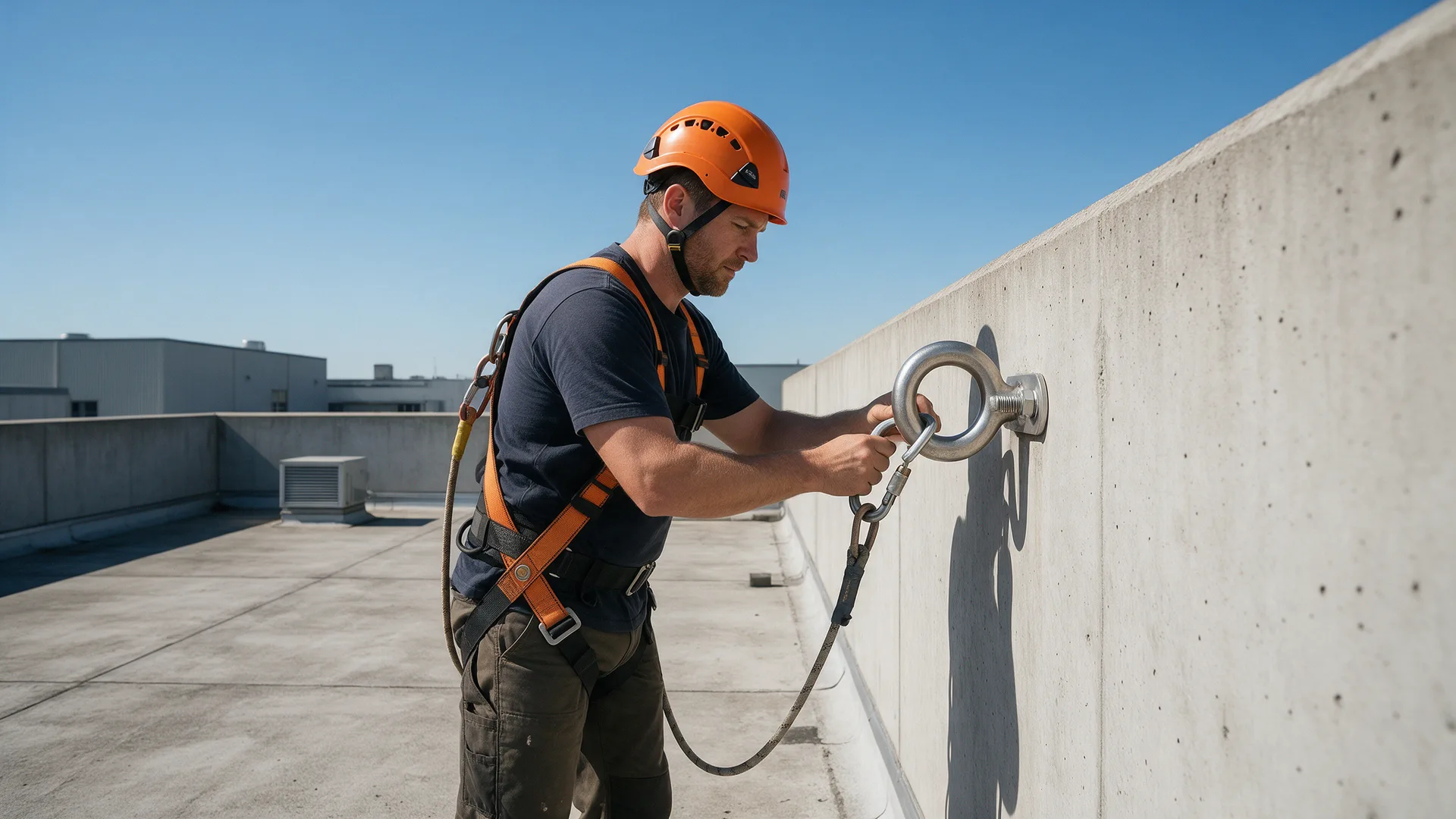
An anchor point is the connection point to which a person working at height attaches their fall arrest system, and which safely transfers the load of a fall into the structure. However good the harness, lanyard and karabiner are, the system will not work if the anchor they are attached to cannot carry the load. Under EN 795, anchor devices are divided into five types. The most common on site are permanently installed anchor eyes, along with transportable anchor slings and door anchors. Choosing the right one depends on the type of structure, whether the work is permanent or temporary, and where the anchor sits in relation to the work position.
What Is an Anchor Point and Why Is It So Critical?
A fall arrest system always has three parts: the anchor, the connecting element (a lanyard, self-retracting lifeline or lifeline) and the full body harness. The anchor is the first link in the chain, and the entire force of a fall ends up passing through it into the structure.
That is why an anchor has to meet two conditions at the same time:
- The anchor device must be strong: The product must be tested to EN 795 and carry a CE mark.
- The structure it is fixed to must be strong: Even the best anchor eye offers no protection if it is fixed to crumbling concrete, thin sheet metal or a non-load-bearing element.
One of the most common mistakes on site is using elements that were never designed as anchors. Guardrails, pipework, cable trays and scaffold braces are not anchor points unless a competent person has verified their load capacity. We cover these mistakes in detail in our article on anchor mistakes.
What Are the EN 795 Anchor Types?
EN 795 divides the anchor devices used in personal fall protection systems into five types:
- Type A: Structural anchors permanently fixed to the building. Anchor eyes fixed to concrete, steel or timber with anchors, bolts or welding belong to this group.
- Type B: Transportable, temporary anchors. Anchor slings, door anchors, beam clamps and tripods are Type B. They are removed when the job is done and reused on another site.
- Type C: Flexible horizontal lifelines made of steel or synthetic rope that let the worker move along the line.
- Type D: Rigid horizontal rails. The worker stays connected through a trolley that runs along the rail.
- Type E: Deadweight anchors. On flat roofs they create an anchor point by their own weight, without drilling into the structure.
EN 795 tests devices for a single user. If more than one worker needs to attach to the same anchor, the product must be separately approved for multiple users; this is stated on the product label and in the user manual.
Anchor Eye: The Permanent Solution
An anchor eye is a Type A anchor permanently installed on the structure and used again and again. It is the most reliable solution on roofs, façades, machinery and any point that is accessed regularly for maintenance.
Points to watch with anchor eyes:
- Installation must be carried out by a competent person. The anchor type, hole diameter, concrete grade and tightening torque specified by the manufacturer must be followed exactly.
- Installation must be documented. Record where each anchor was installed, when, by whom and with which fixing.
- The material must suit the environment. Stainless steel is preferred outdoors, near the sea or in chemical environments.
The EKS-144 Anchor Eye complies with EN 795 and has a minimum breaking strength of 30 kN horizontally and vertically. It is installed with the EKS-143 Anchor Eye Fixing.
Anchor Sling: For Beams and Structural Members
An anchor sling is a textile Type B anchor wrapped around a steel beam, concrete column or other strong structural member to create a temporary anchor point. It is light, needs no installation and moves easily from site to site.
For safe use of an anchor sling:
- The member must be able to carry the load. The beam or column must be load-bearing, and the sling must not be able to slide off it.
- Protect it from sharp edges. If the sling is wrapped around an angular section, use an edge protector.
- Use it only as the manual allows. Choking the sling (passing it through itself) can affect its strength; do not use configurations that the manufacturer does not permit.
- The anchor should be at or above shoulder height. A sling attached to a beam at foot level increases both the fall distance and the fall force.
The EKS-256 Anchor Sling has steel D-rings at both ends and comes in lengths from 0.60 to 2 metres to suit different beam sizes. If the length needs to be adjusted on site, the EKS-256-A Adjustable Anchor Sling is a good choice.
Door Anchor: For Indoor and Maintenance Work
A door anchor is a Type B anchor placed across the inside of a door or window frame, turning the opening into a temporary anchor point. No drilling or installation is needed. It is a practical solution for façade maintenance, glazing, lift shafts and roof access doors.
When using a door anchor, the frame itself must be load-bearing. Thin frames fitted in lightweight partition walls are not suitable. The anchor must be positioned so that the load acts perpendicular to the frame, on the opposite side to the direction of work.
The EKS-265 Door Anchor adjusts to openings from 60 to 130 cm, needs no installation tools and has rubber buffers at the corners to protect the frame.
How to Choose the Right Anchor Point
Once the anchor type is decided, its position matters just as much as the product. Ask these questions:
- Is the anchor above the worker? The ideal anchor point is at or above shoulder height, which keeps the free fall distance to a minimum.
- Is the anchor directly above the work position? If the anchor is far to the side, the worker swings like a pendulum in a fall and can hit nearby structures.
- Is there enough clearance below? Take into account the lanyard length, the energy absorber extension and the worker’s height. See the method in our fall distance article.
- Is the work permanent or temporary? Permanent anchor eyes suit points with regular maintenance; transportable slings and door anchors suit one-off or changing work.
- Is rescue possible? The anchor point should also allow a fallen worker to be rescued quickly.
Anchor Checks and Periodic Inspection
Transportable anchors (slings and door anchors) must be checked by the worker before every use. On textile slings, look for cuts, wear, burns and stitching damage; on metal parts, look for cracks, deformation and corrosion. A damaged anchor, or one that has arrested a fall, is taken out of service.
Permanent anchor eyes must be inspected by a competent person after installation and at the intervals set by the manufacturer, at least once a year. Keeping a record of inspection results and of where the anchor points are located matters for both safety and legal compliance. For general care rules, see our equipment maintenance guide.
Frequently Asked Questions
Is an anchor the same as an anchor point?
The anchor point is the place where the fall arrest system is attached. The anchor device is the product that creates that point, such as an anchor eye, sling or door anchor. A safe anchor point needs both a strong device and a strong structure.
What is the difference between an anchor eye and an anchor sling?
An anchor eye is a metal Type A anchor permanently fixed to the structure. An anchor sling is a textile Type B anchor wrapped around a beam or column that can be removed and carried to another site.
Can more than one person attach to one anchor point?
EN 795 anchors are tested for a single user. If several people will attach, the manufacturer’s documents must clearly state that the product is approved for multiple users.
Is it safe to tie off to a guardrail or pipe?
No. Guardrails, pipes and cable trays are not designed for fall loads. They must not be used as anchors unless a competent person has verified their load capacity.
How often should an anchor eye be inspected?
After installation and at least once a year by a competent person. An anchor that has arrested a fall must not be used again before it has been inspected.
A Safe System Starts with the Right Anchor
The anchor point is the hidden foundation of any work at height system. Without an anchor of the right type, in the right position and fixed to a sound structure, a harness and lanyard cannot protect anyone on their own. Anchor eyes on permanent work points, and anchor slings and door anchors on changing sites, give the flexibility the job needs without compromising safety.
With more than 20 years of experience, EKS Work Safety supplies EN 795 compliant anchoring solutions as part of a complete system with harnesses, lanyards and lifelines. To find the right anchor point for your site, get in touch with EKS Work Safety.
For more, visit our LinkedIn page.

 by
by