
 English (UK)
  Türkçe
  العربية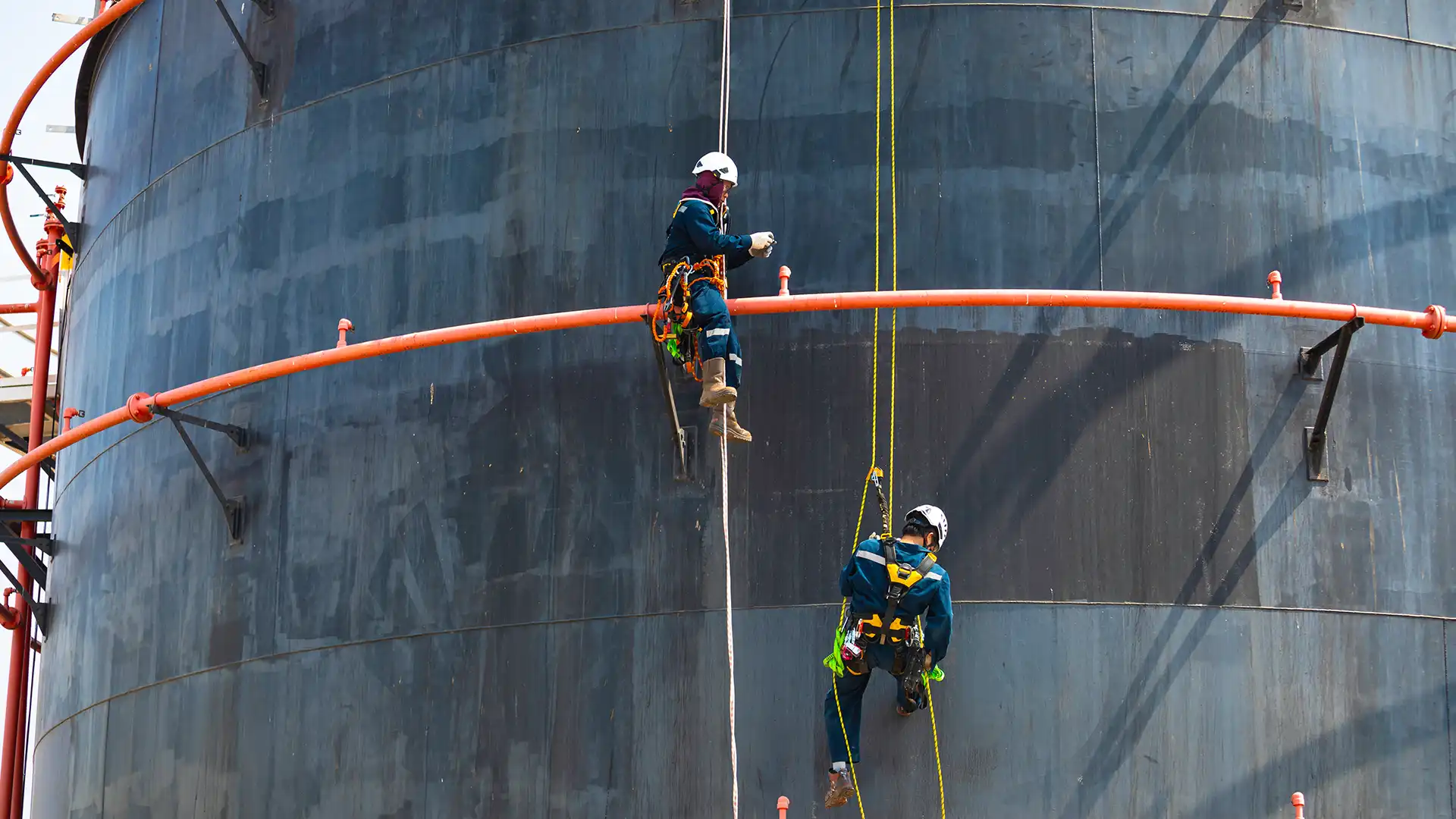
Work at height equipment provides real safety not when evaluated individually, but when considered as a system that works together. Equipment such as harnesses, lanyards, retractable fall arrests, and carabiners, when properly integrated, create a structure that effectively controls fall risk. EKS Work Safety approaches these components with an integrated system perspective to enhance on-site safety.
One of the most critical mistakes in the field is treating these components as independent products. However, safety at height depends on how these elements function together as a system.
How Do Work at Height Equipment Systems Work?
Work at height equipment essentially forms a fall arrest system. This system not only stops a fall when it occurs but also manages the forces generated during the fall in a controlled manner.
This system operates in three main stages:
- Connection: Securing the worker to a safe anchor point
- Fall arrest: Stopping sudden movement
- Force distribution: Balancing the load applied to the body
At each stage, different equipment components come into play and function together. EKS Work Safety provides solutions tailored to field requirements to ensure this system is correctly structured.
Why Is the Harness the Most Critical Component of the System?
Among work at height equipment, the harness is the most critical component forming the foundation of the entire system. This is because it is the only element that directly transfers fall forces to the body. No matter how well the system is designed, if the harness cannot manage these forces safely, protection cannot be ensured.
Especially safety harnesses:
- Provide full-body support with shoulder, waist, and leg straps
- Prevent force from concentrating on a single point
- Help maintain a balanced position after a fall
However, a harness alone is not a fall arrest solution. Real safety is achieved only when it works together with other components such as lanyards, retractable fall arrests, and carabiners. EKS Work Safety evaluates harnesses as part of this integrated system.
How Do Lanyards and Connection Lines Complete the System?
A lanyard establishes the connection between the harness and the anchor point. This connection is the critical element that activates the system.
Different types of lanyards are used depending on the working scenario:
- Fixed lanyard: For workers operating in a defined area
- Double leg lanyard: For tasks requiring continuous connection
- Energy absorbing lanyard: To reduce forces during a fall
When an energy absorbing lanyard is used, the energy generated during a fall is absorbed, significantly reducing the load transmitted to the body.
How Does a Retractable Fall Arrest System Engage?
A retractable fall arrest is one of the fastest-responding components in the system. During operation, the line moves freely, but in the event of a sudden fall, the mechanism locks automatically.
This system:
- Minimizes slack in the line
- Reduces fall distance
- Activates within milliseconds
These systems offer high safety performance, especially in dynamic work environments. EKS Work Safety prioritizes high safety standards in retractable fall arrest systems.
Carabiners and Anchors: Critical Connection Points of the System
Among work at height equipment, one of the smallest yet most critical components is the carabiner. It is the mechanical element that connects all parts of the system.
In a properly configured system:
Harness → Lanyard → Carabiner → Anchor line
forms the connection chain.
Key criteria for selecting carabiners include:
- Locking mechanism (automatic / screw gate)
- Load capacity
- Material strength
- Application scenario
A weak connection element can compromise the entire system.
What Happens If the System Is Not Properly Configured?
If work at height equipment is not properly integrated, the system will not perform as expected.
In such cases:
- Fall distance may increase
- Forces on the body may become uncontrolled
- Connection points may be overloaded
- Secondary impact risks may occur
Therefore, having individually correct equipment is not sufficient. System integrity is essential, and this can only be achieved with the right equipment selection. EKS Work Safety stands out with its system-focused approach at this stage.
How to Build a Safe Work at Height System?
To create an effective system, the following principles should be applied:
- The harness must be used from the correct attachment point
- Lanyard or retractable fall arrest systems should be selected based on the work environment
- Energy absorbers must be used where required
- Compatibility between carabiners and anchors must be ensured
- All equipment should be tested together
This approach reveals the true performance of work at height equipment.
Integrated System, Maximum Safety
Work at height equipment cannot be used effectively without proper knowledge and field experience. EKS Work Safety offers harnesses, lanyards, retractable fall arrests, and carabiners not as standalone products, but as part of an integrated safety system.
With site-specific solutions, the goal is to ensure that all equipment works together in the most efficient way. You can contact us to determine the most suitable system for your work environment and to control risks effectively.
Visit our LinkedIn page to learn more.

 by
by