
 English (UK)
  Türkçe
  العربية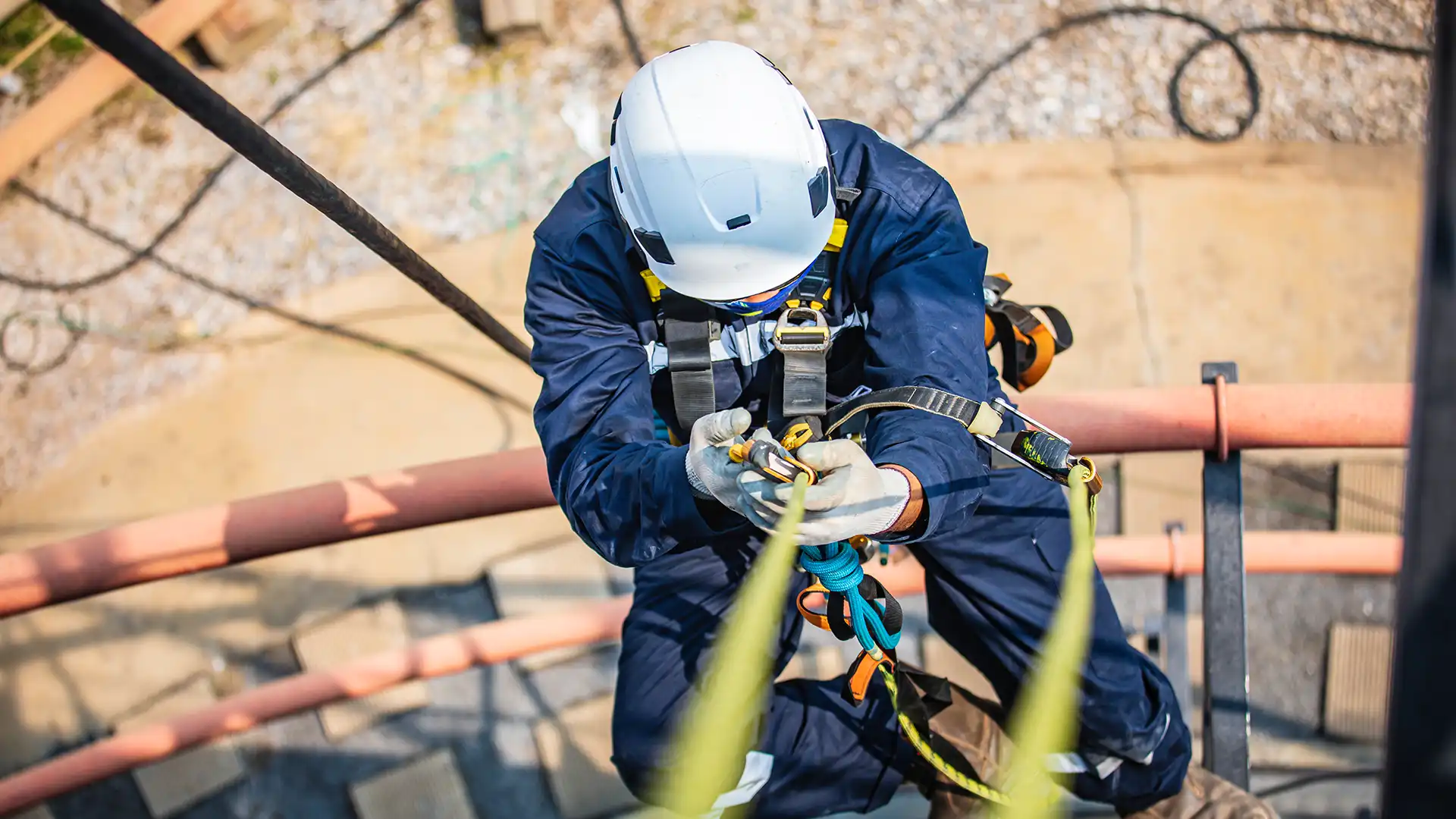
In work at height, retractable fall arresters are among the most advanced fall protection systems. However, in some on-site applications, the expected level of performance is not always fully achieved. In most cases, this is not due to product inadequacy, but rather to improper management of the use scenario, system compatibility, and site conditions.
When retractable fall arresters are used together with the correct safety harness, appropriate carabiners, and properly positioned anchor points, they provide maximum protection. If any link in this safety chain is weak, the system may fail to deliver the expected performance.
What Does the Performance of a Retractable Fall Arrester Depend On?
The performance of a retractable fall arrester is not fixed; it varies depending on the working environment and how the system is used.
The main factors that directly affect performance include:
- Working height and free fall distance
- Frequency of user movement and directional changes
- Position and height of the anchor point
- Connection geometry between the system and the safety harness
- Type of carabiners and connecting components used
When these factors are not evaluated together, the system may stop a fall but still fail to provide a comfortable and controlled arrest.
How Does Anchor Position Affect Performance?
The locking mechanism of a retractable fall arrester is extremely sensitive. However, this sensitivity can become a disadvantage if the anchor point is incorrectly positioned.
In particular:
- When the anchor point is below user level
- In long horizontal connections
- In areas with edge and corner contact
the system may lock later or the stopping distance may increase.
For this reason, a retractable fall arrester must be used with the correct anchor point, the correct carabiner, and an appropriate connection angle.
Can Safety Harness and Connection Compatibility Be Ignored?
No. A retractable fall arrester is not a standalone piece of equipment. Its performance must always be evaluated together with a full body harness.
Key points to consider:
- The safety harness must comply with fall arrest standards
- Connection points must be used correctly
- Carabiners must have reliable locking mechanisms
An incompatible safety harness or incorrect connection point can limit the performance of even the most advanced system.
The Effect of Combining Lanyards and Energy-Absorbing Lanyards
On some sites, retractable fall arresters are used as complementary systems together with lanyards or energy-absorbing lanyards. However, if this combination is not properly planned, performance may decrease.
For example:
- Using unnecessarily long lanyards
- Failing to account for the deployment distance of the energy-absorbing lanyard
- Leaving excessive tolerance at connection points
These situations can reduce the system’s rapid response advantage. Retractable fall arresters operate on the principle of minimal slack and fast locking; when this balance is disrupted, performance also declines.
Why Do Site Dynamics Play a Critical Role?
No two work-at-height sites are the same. Wind, sloped surfaces, confined spaces, or constant directional changes directly affect system behavior.
Especially in:
- Towers and energy lines
- Platform and scaffold work
- Areas using horizontal lifelines
proper positioning of the retractable fall arrester and overall system integrity are vital.
Is It a Performance Issue or an Application Issue?
When the “expected performance” is not achieved on site, the problem is often not the equipment itself, but the application details.
The most common causes include:
- Incorrect anchor selection
- Incompatible safety harness
- Improper carabiner use
- Failure to evaluate system components together
For this reason, a retractable fall arrester should be considered as part of an integrated system, not as a standalone solution.
The EKS Work Safety Approach
EKS Work Safety evaluates retractable fall arrester solutions not merely as individual products, but as integrated safety systems working together with lanyards, energy-absorbing lanyards, safety harnesses, and carabiners.
This approach enables:
- Improved system compatibility
- Minimized performance losses
- Site-specific safety solutions
Expected Performance Is Achieved with the Right System
When used in the correct scenario, a retractable fall arrester is a highly effective safety solution. However, sustainable performance depends on using the equipment with the right components, in the right environment, and with the correct connections.
To determine the most suitable fall arrest systems for your worksite, ensure proper safety harness and carabiner compatibility, and maximize system performance, you can contact us.
Visit our LinkedIn page to learn more.

 by
by