
 English (UK)
  Türkçe
  العربية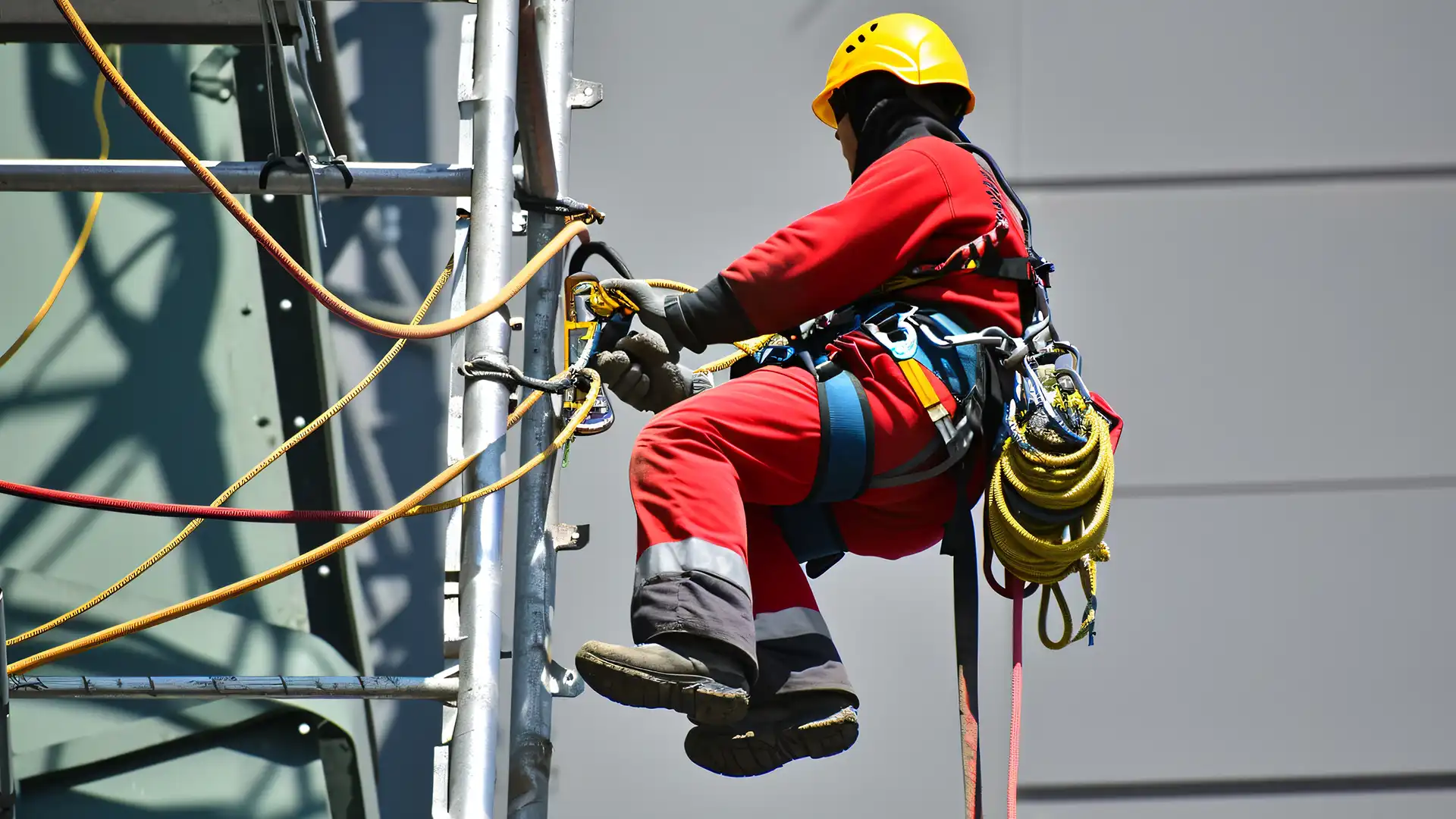
Working at height in telecom and energy carries more complex and layered risks than standard construction sites: vertical climbing of tall towers and poles, electrical and arc hazards, variable weather conditions, limited access, and the possibility of prolonged suspension all occur together. In these sectors, safety is provided not just by wearing a harness, but by a system consisting of vertical lifelines, a double leg lanyard, correct anchoring, and a ready rescue plan.
In this article, we address the unique hazards of working at height in the telecommunications and energy sectors, the correct equipment and system design against these hazards, and the most common mistakes made in the field.
Why Are Telecom and Energy Sites Different?
Most work at height sites operate on a fixed platform or scaffold. Telecom and energy sites are different: the worker usually rises by climbing a vertical structure (tower, pole, turbine) and is constantly in motion throughout the work. This makes uninterrupted connection, that is, continuous safety, mandatory.
A person working on a base station tower, a power transmission line pole, or a wind turbine tower faces different risks while climbing, changing position, and working. A single piece of equipment cannot meet all of these risks; this is why sectoral work at height requires a task-specific system design.
Risks of Working at Height in Telecommunications
Telecom infrastructure is shaped around base station towers, antenna poles, and rooftop installations. The main risks in this work:
- Falling during vertical climbing: Safety must be maintained at all times while climbing a tower or pole. With a single leg lanyard, there is an interruption as the connection passes from one point to another; this is the riskiest moment.
- Loss of connection while changing position: A technician changing position to reach an antenna must be able to move without breaking the connection.
- Falling objects: Hand tools and parts used at height pose a danger to the team below.
- Prolonged suspension: On limited-access tower tops, rescue may be prolonged in the event of a fall; the risk of suspension trauma increases.
The basic solution against these risks is continuous connection with a double leg (Y-type) lanyard: The technician never remains unsecured by attaching one leg to one point and the other leg to the next point. Vertical lifelines and retractable fall arrests also complete climbing safety.
Risks of Working at Height in the Energy Sector
The energy sector covers power transmission lines, substations, wind farms, and refinery/plant maintenance work. Here, an electrical hazard is added to the work at height risk.
- Electrical and arc risk: When working on power transmission line poles and substation areas, maintaining certain safety distances from live parts is of vital importance. A possible arc flash can be fatal.
- Vertical pole climbing: Climbing energy poles requires continuous safety similar to telecom towers. Rail or steel rope vertical lifelines on the pole body automatically lock during a fall and hold the worker.
- Height and weather conditions: Poles in open terrain are exposed to wind, rain, and ice; these conditions increase the risk of falling.
In energy sites, the fall protection system must be addressed together with electrical safety measures (insulating equipment, arc-resistant clothing, safety distances). When choosing work at height equipment, the electrical hazard in the field must also be taken into account.
Wind Energy: The Most Dynamic Work at Height Environment
Wind power plants are one of the most challenging examples of working at height. Tower heights exceed 100 meters, and technicians work in the nacelle (turbine top), hub, and blade areas.
Critical elements at wind farm sites:
- Vertical lifelines are mandatory: Active use of vertical lifelines and fall arrest systems is essential when climbing the turbine tower.
- Wind limit: During work on the nacelle, wind speed is monitored in real time; work is stopped when certain limit values (usually 12-15 m/s) are exceeded.
- Confined space risk: The turbine blade interior and hub area fall into the confined space class; they require additional measures.
- Rescue at height: A rescue operation at 100 meters requires special equipment and training; the rescue plan must be ready in advance.
The Most Common Mistakes at Sectoral Sites
At telecom and energy sites, there are critical mistakes repeated even by experienced teams:
- Connection interruption while climbing: Remaining unsecured during the transition while climbing with a single leg lanyard. Solution: continuous connection with a double leg lanyard.
- Not calculating the fall distance: If the lanyard length, energy absorber deployment, and anchor height are not calculated together, an impact can occur even if the fall is arrested. This risk increases especially with anchors close to foot level.
- Mistaking every solid-looking point for an anchor: Using an attachment point without verifying that it actually has sufficient strength.
- No rescue plan: The fall arrest equipment is present, but there is no plan to quickly bring down a suspended person. This is one of the most fatal gaps at sectoral sites.
The common point of these mistakes is this: the presence of equipment does not mean the system is set up correctly. Real safety is provided by task-specific planning.
The Right System: A Task-Focused Approach
The right approach for working at height in telecom and energy is task-focused, not product-focused. That is, before the question “which harness?”, the question “which task, which risk?” is asked:
- A front-attachment harness and double leg lanyard for vertical climbing
- A vertical lifeline or retractable fall arrest for the tower/pole body
- An EN 358-supported solution for work requiring positioning
- An anchor plan and fall distance calculation for each task
- A pre-rehearsed rescue plan suited to the site type
EKS Work Safety’s harnesses, double leg lanyards, retractable fall arrests, vertical and horizontal lifelines, anchors, and rescue equipment come together as a system precisely to support this task-focused approach.
Frequently Asked Questions
Why is a double leg lanyard needed when climbing a telecom tower?
With a single leg lanyard, there is an interruption as the connection passes from one point to another while climbing. A double leg (Y-type) lanyard, when used so that one leg always stays attached, provides uninterrupted safety throughout the climb.
How does electrical risk affect work at height safety when working on an energy pole?
At energy sites, the fall protection system must be planned together with electrical safety measures. Safety distance to live parts must be maintained, and insulating equipment and arc-resistant clothing must be used when necessary.
At what wind speed is work on a wind turbine stopped?
During work on the nacelle, wind speed is continuously monitored and work is usually stopped when certain limit values such as 12-15 m/s are exceeded. The exact limit is determined according to manufacturer and site procedures.
Why is a rescue plan so important at sectoral sites?
At limited-access tall structures such as towers, poles, and turbines, rescue can be prolonged. Because suspension trauma develops within minutes, a pre-prepared and rehearsed rescue plan is of vital importance.
Sector-Specific Risks, System-Specific Solutions
Working at height in telecom and energy carries unique risks beyond standard sites, such as electrical hazards, vertical climbing, and limited access. Against these risks, not a single piece of equipment but a system consisting of the right harness, a lanyard providing continuous connection, vertical lifelines, planned anchoring, and a ready rescue plan is needed.
With over 20 years of experience, EKS Work Safety provides work at height solutions suited to field realities for the telecommunications, energy, construction, defense, and fuel sectors. To set up a standards-compliant safety system specific to your site and tasks, you can contact EKS Work Safety.
Visit our LinkedIn page to learn more.

 by
by