
 English (UK)
 Türkçe
 العربية
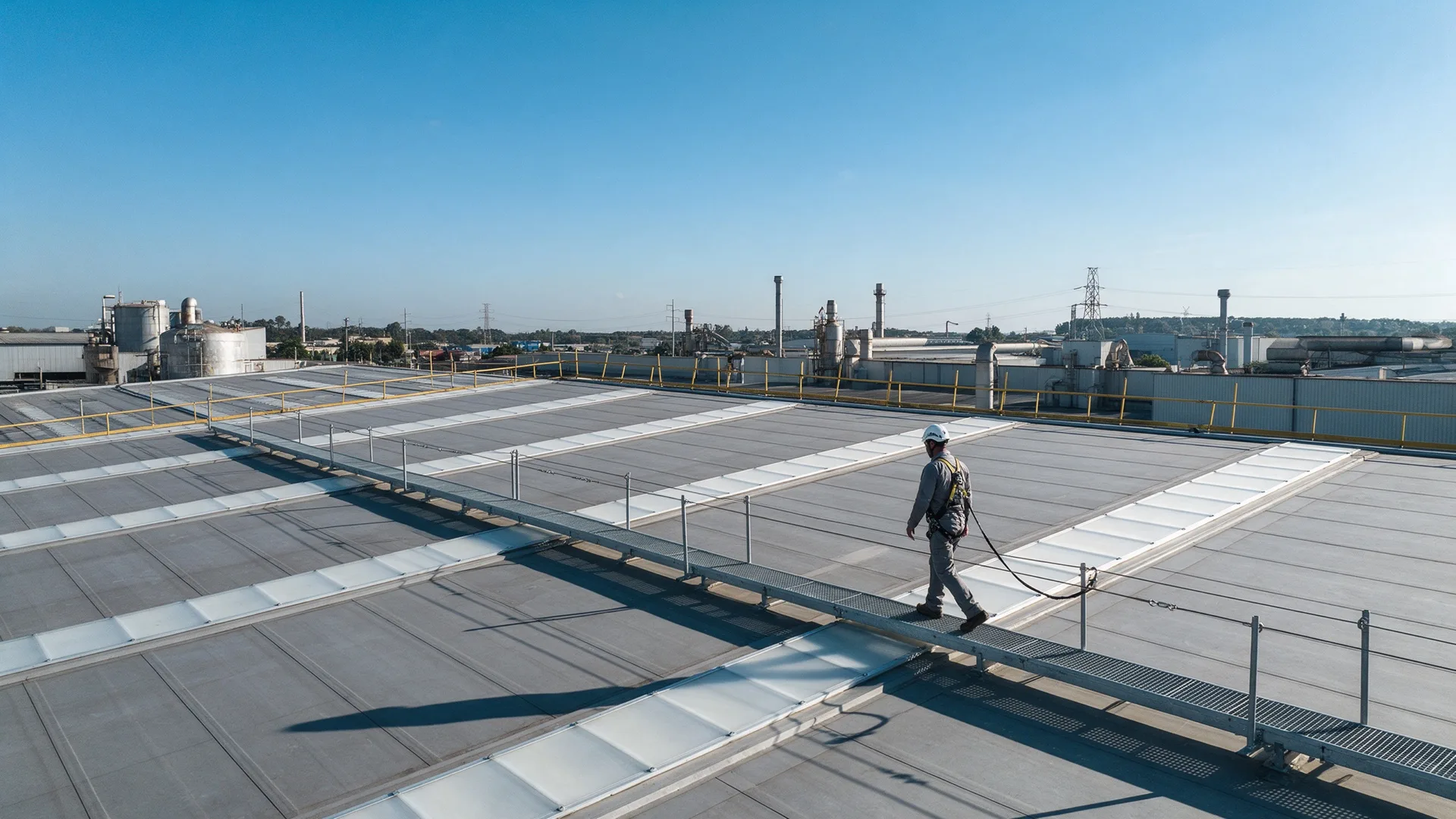
Roof work safety is one of the least forgiving areas of work at height. Roofs and floor edges are among the most common places for falls from height. The risk comes from three sources: unprotected roof edges, roof surfaces that break when stepped on, and anchors that are badly chosen or wrongly used. This guide explains the order in which to control these three risks, where to connect a full body harness on a roof and gives you a checklist to use before work starts.
Why Are Falls from Roofs So Common?
Roof jobs are often short and non-routine: fixing a leak, clearing a gutter, servicing an air conditioning unit, replacing a few panels. The idea of a “five-minute job” leads people to skip planning and collective protection. Common roof fall scenarios include:
- Falls from the edge: From a roof edge, eaves or roof opening without guardrails or a parapet.
- Falls through fragile surfaces: Stepping on a roof light, fibre cement sheet, an old or corroded sandwich panel or glass.
- Slips on pitched roofs: Sliding to the edge on a wet, icy or mossy surface.
- Falls during access: When stepping from a ladder onto the roof or walking unprotected to reach an anchor.
Collective Protection First, Then Personal Protection
Turkish Occupational Health and Safety Law No. 6331 requires collective protection to take priority over personal protection. The Regulation on Occupational Health and Safety in Construction Works also requires work that does not have to be done at height to be done on the ground wherever possible, and workers to be protected first by collective measures such as guardrails, platforms and nets. On a roof, the hierarchy works like this:
- Avoid the work at height: If the job can be done from the ground (long-reach tools, a mobile elevating work platform, drone inspection), nobody goes onto the roof.
- Collective protection: Guardrails at the roof edge, covers over fragile surfaces or safety nets beneath them, fixed covers over roof openings.
- Work restraint: A connection short enough that the worker can never reach the edge or a fragile surface.
- Fall arrest: Where a fall cannot be prevented, a system that stops the fall safely.
Under the regulation, guardrails must have a top rail at least one metre above the platform that can withstand a load of at least 125 kg from any direction, a toe board at least 15 cm high, and an intermediate rail so that no gap between the toe board and top rail exceeds 47 cm. We covered employers’ wider duties in our work at height regulation article.
Fragile Roofs: The Hidden Opening
A fragile roof is any roof surface that cannot safely support the weight of a person standing on it. Roof lights, fibre cement sheets, ageing sandwich panels and glass roofs all fall into this group. They are dangerous because they are hard to tell apart from solid surfaces: a roof light covered in dust, paint, snow or moss looks just like the panels around it.
The Regulation on Occupational Health and Safety in Construction Works requires measures for roof work such as edge protection systems, roof ladders, safety nets, working platforms, guarded scaffolds, anti-slide systems or vertical and horizontal lifelines. On surfaces made of fragile material, every necessary measure must be taken to stop workers from walking on them inadvertently or falling.
Basic rules for fragile roofs:
- Never step on a fragile surface. A loose plank is not enough; use a load-spreading walkway or working platform with edge protection.
- Cover roof lights or install nets beneath them. Covers should be fixed in place and marked “fragile roof”.
- Put a warning sign at every roof access point.
- Use a work restraint system so the worker physically cannot reach the fragile area.
A common mistake on site is assuming a worker is safe on a fragile roof because they are wearing a harness. A harness arrests a fall, but if there is not enough clearance below, the worker can still hit the ground. Always calculate the fall clearance.
Where to Connect a Harness on a Roof
A full body harness only protects the wearer when it is connected to a suitable anchor. On a roof, the options are:
Fixed anchor points
Anchors permanently installed in the roof structure are the most reliable solution for roofs that need regular maintenance. The anchor must be fixed to a load-bearing member and its suitability documented. Vent pipes, gutters, air conditioning frames and roof sheet screws are not anchors. For anchor types and selection, see our anchor point guide.
Horizontal lifelines
For teams moving along a roof, a horizontal lifeline lets the worker stay connected at all times without unclipping. Fixed lifelines suit permanent tasks and mobile horizontal lifelines suit temporary work. The line should be positioned so that the worker either cannot reach the edge or, if they do, the fall is arrested safely. We compared the two systems in our fixed and mobile lifelines article.
Ridge anchors on pitched roofs
On pitched roofs, the anchor is placed on the ridge where possible, and the worker works below the anchor at a balanced angle. The further the worker moves sideways from the anchor, the greater the swing fall effect: in a fall, the worker can swing sideways into the roof edge or an obstacle.
Watch out for connections over an edge
If the anchor is at foot level or on the roof surface and a fall would go over the roof edge, the lanyard or self-retracting lifeline line will run over that edge. For this use, choose equipment that the manufacturer states has been edge tested and is suitable for horizontal use. This information is on the product label and in the user manual.
Roof Work Checklist
- Have roof edges, openings and fragile surfaces been identified and marked?
- Is there a guardrail or parapet at the edge, or has temporary edge protection been installed?
- Have roof lights been covered or safety nets installed beneath them?
- Have anchor points and lifelines been identified and their suitability confirmed?
- Has the choice between work restraint and fall arrest been made, and fall clearance calculated?
- Is there safe access to the roof (secured ladder, scaffold tower)?
- Has the method for lifting materials been planned and the area below closed off?
- Are weather conditions suitable? For wind and ice, see our working at height in winter guide.
- Is a rescue plan ready and has the team been briefed?
- Has a work at height permit been issued and approved after an on-site check?
Frequently Asked Questions
What is a fragile roof?
A roof surface that cannot safely support the weight of a person. Roof lights, fibre cement sheets, old or corroded panels and glass roofs are treated as fragile. Unless proven otherwise, plan every roof surface as if it were fragile.
Is roof repair considered work at height?
Yes. The Turkish Regulation on Occupational Health and Safety in Construction Works defines work at height as work in any area with a difference in level where a fall could cause injury. Roof repairs, gutter cleaning and servicing equipment on a roof are all included.
How high should roof edge guardrails be?
Under the Turkish Regulation on Occupational Health and Safety in Construction Works, the top rail must be at least one metre above the platform and withstand at least 125 kg, with a toe board of at least 15 cm and an intermediate rail keeping gaps to no more than 47 cm.
Is it safe to tie off to a vent pipe on a roof?
No. Vent pipes, gutters, air conditioning frames and sheet screws are not designed to take fall arrest forces. Connect only to a documented anchor point or lifeline.
What is the difference between work restraint and fall arrest?
Work restraint stops the worker from ever reaching a point where they could fall. Fall arrest stops a fall safely after it has started. On roofs, work restraint should be used wherever possible.
Roof Safety Starts with Planning
Most roof falls come from precautions skipped for a job that “only takes a few minutes”. Guarding the edge, covering fragile surfaces or netting beneath them, choosing the right anchor and, where possible, setting up a system that keeps the worker away from the edge removes most of the risk before work begins.
EKS Work Safety provides complete fall protection solutions for roof work, including anchors, mobile horizontal lifelines, fixed lifelines, safety nets and harnesses. For an assessment of your site, use our work at height inspection service, or get in touch with EKS Work Safety for more information.
For more, visit our LinkedIn page.

 by