
 English (UK)
 Türkçe
 العربية
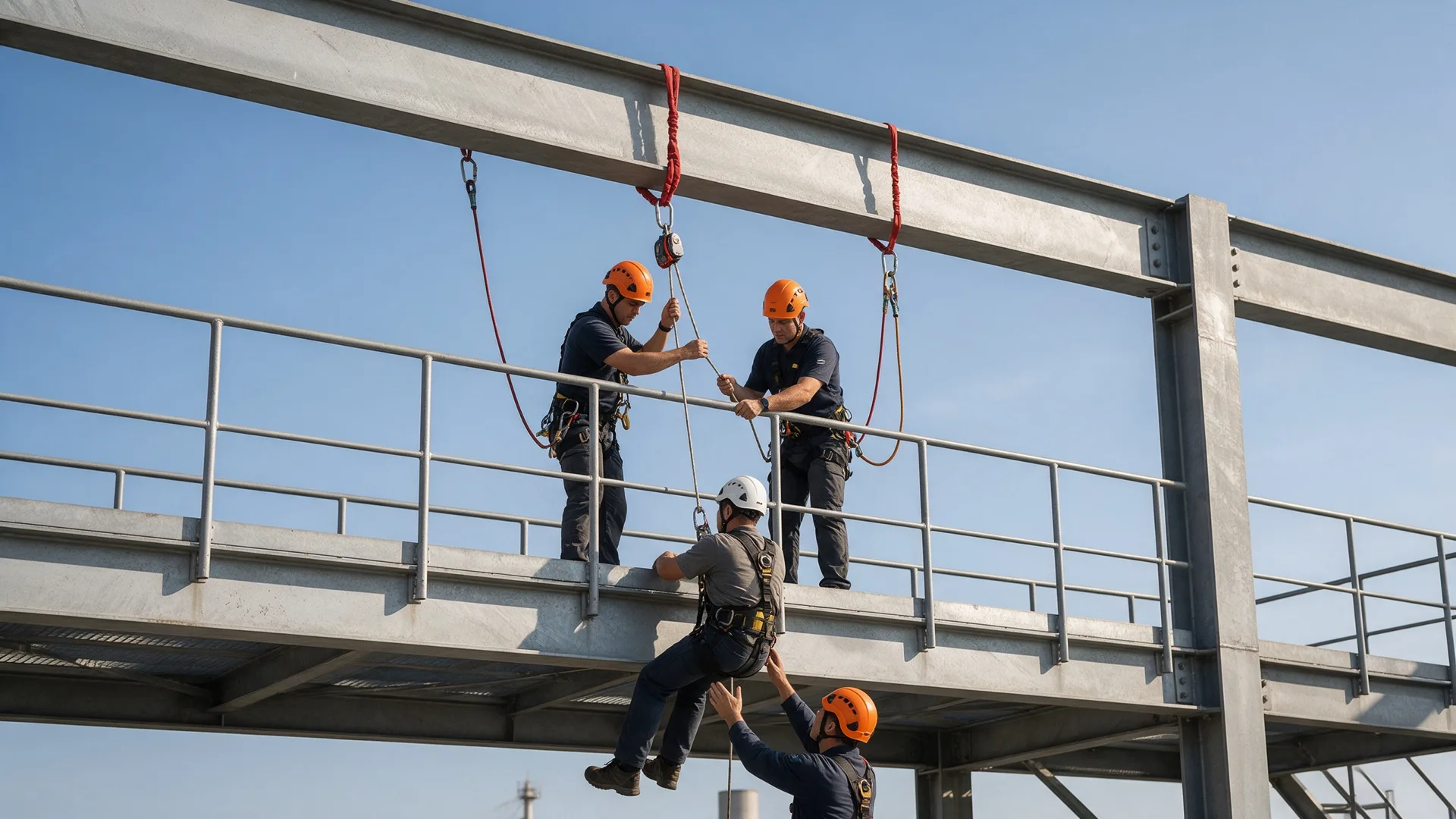
A work at height rescue plan is a site-specific procedure, prepared in advance, for bringing a worker whose fall has been arrested down to a safe place as quickly as possible, without putting the rescuers at risk. A full body harness and fall arrest system stop the fall, but they do not lower the worker to the ground. Every minute spent in suspension is a risk, so rescue should not be something worked out on the day; it should be planned and practised before work begins. This guide explains what a rescue plan should include, the main rescue methods and how to keep the plan working on site.
Why Do You Need a Rescue Plan?
Fall arrest systems save lives, but a new risk starts the moment a fall is arrested. In a worker hanging motionless in a harness, the leg straps restrict blood circulation, and a serious condition can develop quickly, potentially leading to loss of consciousness. We explained how this develops in our suspension trauma article.
That is why speed is the core principle of any rescue plan. Calling the emergency services is always one of the first steps, but it cannot be the whole plan: crews need time to reach the site, get to the height and set up a rescue. The plan must be based on rescuing the worker with the team and equipment already on site.
Legal Framework
In Türkiye, Article 11 of Occupational Health and Safety Law No. 6331 requires employers to prepare emergency plans, appoint enough trained people for emergencies, provide the necessary equipment, carry out training and drills, and arrange contact with outside organisations for rescue. The Regulation on Occupational Health and Safety in Construction Works also explicitly requires that, when work at height is planned, falls from height are covered in the emergency plan. In other words, post-fall rescue is a mandatory part of the emergency plan. In practice, the rescue plan is also one of the core sections of the work at height permit to work: a permit with an empty rescue section should not be approved.
Rescue Methods
A rescue plan includes one or more methods depending on site conditions. The simplest and fastest method is always the first choice.
1. Self-rescue
If the worker is conscious and uninjured after the fall, they may be able to reach a nearby platform, ladder or structure themselves. Some systems include devices that allow workers to lower themselves. However, this is impossible if the worker is unconscious or injured, so self-rescue can never be the only plan.
2. Assisted rescue (by access)
A co-worker reaches the suspended worker using a mobile elevating work platform, scaffold tower or ladder, brings them onto a safe platform or transfers their connection to a rescue system. Where suitable access equipment is on site, this is usually the fastest method.
3. Rescue kit lowering
A pre-rigged rescue kit lets the rescuer transfer the suspended worker’s connection to a load-bearing rescue rope and lower them to the ground in a controlled way. These kits include descender devices (EN 341), rescue lifting devices (EN 1496), rope, carabiners and, where needed, a telescopic pole for remote connection. The rescuer can often carry out the rescue without descending to the casualty.
4. Tripod and winch rescue
In wells, tanks, shafts and other confined spaces, or for vertical access, a tripod and rescue winch is used. We covered this in detail in our tripod and rescue winch article.
5. Technical rope rescue
Advanced rescues using pulley systems and ropes on facades, towers or hard-to-reach structures. These should only be carried out by teams specifically trained in them. We explained how pulley systems work in our pulley article.
What Should a Rescue Plan Include?
A good rescue plan is short, site-specific and workable. A generic template cannot cover the different conditions of every site.
- Scenarios: Where could a fall happen, where would the worker be suspended, and what is below?
- Method: Which rescue method will be used for each scenario, and its steps.
- Team and roles: Who carries out the rescue, who calls the emergency services, who makes the area safe. A trained rescuer on site on every shift.
- Equipment: What the rescue kit contains, where it is kept and who checks it. Equipment should be close to the work location and immediately accessible.
- Communication: Radios or phones, emergency numbers, and clear directions to the site address and access route.
- After the rescue: Assessment of the rescued worker by a trained first aider, and a medical check-up even if they show no symptoms.
- Records and review: Reporting the incident, inspecting the equipment used, and withdrawing equipment that arrested a fall from service.
Keeping the Plan Alive on Site
A rescue plan that only exists on paper often fails in a real incident. The only way to know a plan works is to test it.
- Drills: Practise the rescue with a realistic scenario and real equipment. Under the Turkish Regulation on Emergencies at Workplaces, emergency drills must be held at least once a year, with the date, gaps found and follow-up actions recorded on a drill form. Drills show how long the plan actually takes.
- Training: The rescue team must be trained in the equipment and methods they will use.
- Update on change: Review the plan whenever the site, job, team or equipment changes.
- Equipment checks: Like all work at height equipment, rescue equipment should be checked before use and inspected periodically. See our maintenance and inspection guide.
Rescue Plan Checklist
- Has a rescue scenario been identified for every work at height location on site?
- Is the rescue method and its steps written down for each scenario?
- Is a trained rescuer on site on every shift, with clear roles?
- Is the rescue equipment close to the work location, complete and checked?
- Is there enough fall clearance below and a safe landing area for the rescue?
- Are communication tools and emergency numbers ready?
- Have first aid and medical follow-up after the rescue been planned?
- Was the plan tested in the last drill and were any gaps fixed?
- Has the rescue section been added to the work at height permit?
Frequently Asked Questions
Is a rescue plan mandatory for work at height?
Yes. Under Article 11 of Law No. 6331, employers must prepare emergency plans, provide equipment, appoint trained people and hold drills. The Regulation on Occupational Health and Safety in Construction Works also requires falls from height to be covered in the emergency plan.
Who prepares the rescue plan?
The plan is prepared on behalf of the employer by the occupational safety specialist, site supervisor and the team doing the work, based on real site conditions. Involving the people who will carry out the rescue makes the plan more workable.
Isn’t calling the emergency services enough?
They must always be called, but that alone is not enough. Crews need time to reach the site and get to the height. The plan should aim to rescue the suspended worker as quickly as possible with the trained team and equipment on site.
What equipment is needed for a rescue?
It depends on the site. Typically a rescue kit (descender or rescue lifting device, rope, carabiners and a telescopic pole where needed), a tripod and rescue winch for confined spaces, and where suitable a mobile elevating work platform or scaffold tower.
Should a rescued worker get a medical check even if they seem fine?
Yes. Suspension can have effects that do not show up straight away. The rescued worker should be assessed by a trained first aider and always sent for a medical check-up.
How often should rescue drills be held?
Under the Turkish Regulation on Emergencies at Workplaces, emergency drills must be held at least once a year at workplaces other than mines, and a drill form completed. As work at height rescue is part of the emergency plan, it should be practised at least that often. Repeating the drill when a new site, team or piece of equipment is introduced is also recommended.
Stopping the Fall Is Only Half the Job
A harness, lanyard and anchor stop the fall; a rescue plan brings the worker safely to the ground. Together they form one system. A site-specific rescue plan with equipment ready, a trained team and regular drills keeps the critical minutes after a fall under control.
EKS Work Safety helps you make your rescue plan workable on site with tripods and rescue winches, pulleys, ropes and carabiners, as well as rescue training. For more information, get in touch with EKS Work Safety.
For more, visit our LinkedIn page.

 by