
 English (UK)
 Türkçe
 العربية
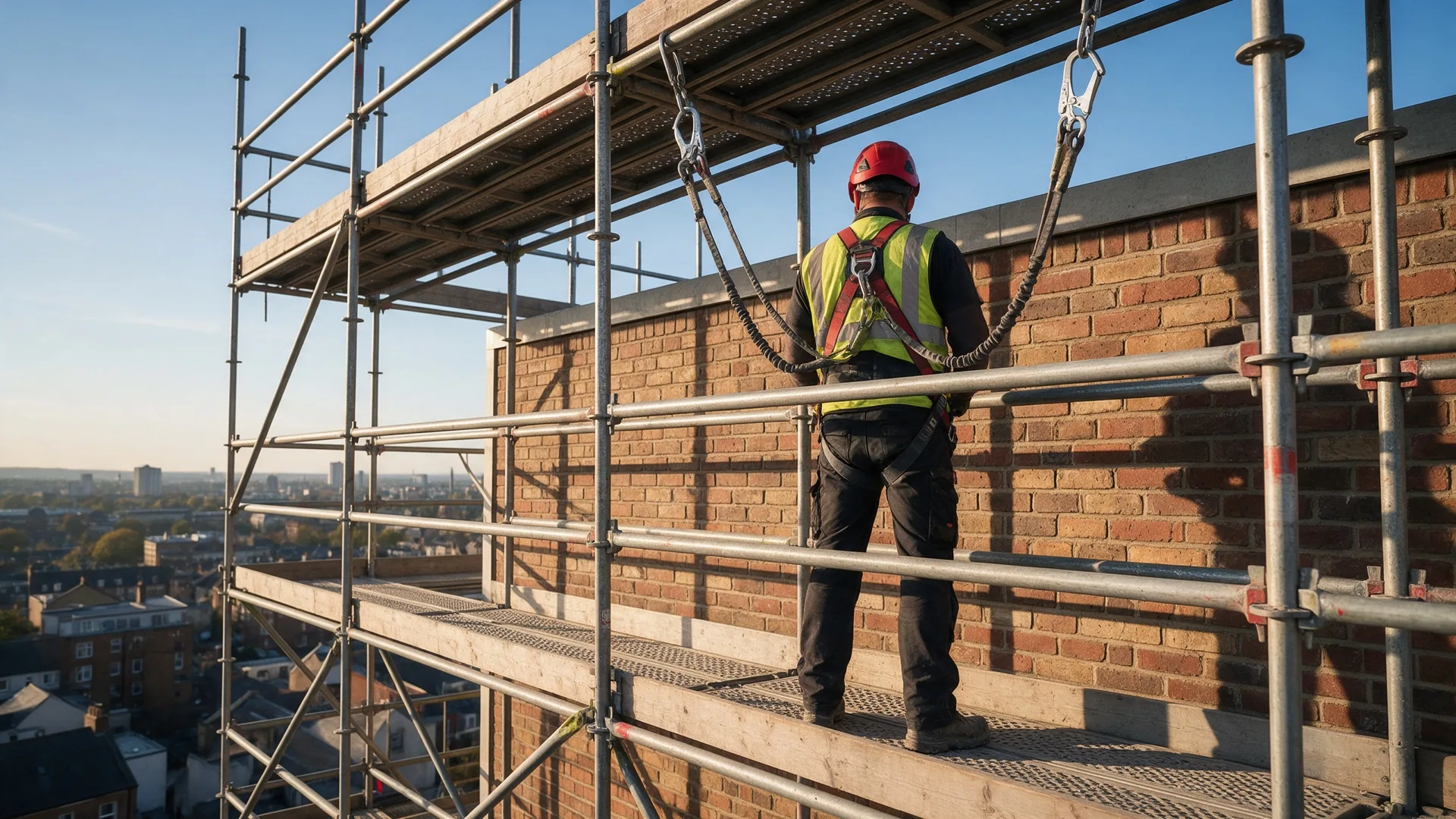
A safety harness is one of the most widely used pieces of fall protection on scaffolding, and one of the most often connected wrongly. On a facade scaffold, the first line of protection against falls is guardrails and a fully boarded platform. A harness becomes vital during scaffold erection and dismantling, where guardrails are missing, when workers reach outside the scaffold, and on suspended scaffolds. To protect the wearer, it must be connected to the right point, with the right equipment, taking fall clearance into account. This guide explains when and where to tie off on each type of scaffold.
Where Does the Fall Risk on a Scaffold Come From?
Most falls from scaffolding are caused not by the scaffold itself but by an incomplete or altered scaffold:
- Levels with guardrails or mid-rails removed and no toe boards
- Platforms that are not fully boarded, have gaps or loose boards
- A wide gap between the scaffold and the building facade
- Levels worked on without protection during erection and dismantling
- Reaching outside the scaffold or standing on the guardrail
- Platforms made slippery by ice, mud or stacked materials
When Is a Harness Needed on Scaffolding?
Turkish Occupational Health and Safety Law No. 6331 requires collective protection to take priority over personal protection. A scaffold with complete guardrails, mid-rails and toe boards, a fully boarded platform and a recorded inspection is the first layer of protection against falls. In that case the harness is a second line of defence, and many site rules make it mandatory at all times.
A harness and a correct connection are essential in these situations:
- Scaffold erection and dismantling: Guardrails have not yet been fitted or have been removed.
- Sections where guardrails are temporarily opened: For loading materials, crane lifts or facade work.
- Reaching outside the scaffold: Work that requires reaching the facade or a point beyond the scaffold.
- Suspended scaffolds (cradles): The platform itself hangs from ropes; the worker must always be connected to an independent lifeline.
- Any unprotected change in level: Other situations identified by the risk assessment.
Where to Tie Off on a Facade Scaffold
The right anchor point
On a scaffold, connections are made to points approved as anchors by the scaffold manufacturer or the competent person who designed the scaffold. These are usually standards close to a node, or ledgers approved for anchoring. The scaffold must also be tied to the building with enough ties; an untied scaffold cannot safely take fall arrest forces.
Can you tie off to a guardrail?
A guardrail is designed to stop a worker leaning against it, not to take the forces generated in a fall. Unless the manufacturer states otherwise, a harness must not be connected to a guardrail. A lanyard on a guardrail can slide along the tube in a fall or pull out the guardrail fixing.
Height of the connection
The anchor point should be at or above shoulder height wherever possible. A connection at foot level increases the free fall distance and the arrest force. Tying off to a standard on the level above is the most practical way to reduce fall distance on a scaffold.
The right equipment
- Full body harness: Fall arrest connection to the rear (dorsal) D-ring.
- Twin-leg (double) lanyard: Keeps one leg connected at all times when moving from one point to another, so the worker is never unclipped.
- Large-opening scaffold hook: A self-locking, large-opening hook that fully closes around the scaffold tube. The gate must close completely around the tube.
- Self-retracting lifeline: On lower lifts there may not be enough clearance for a shock-absorbing lanyard to deploy. A self-retracting lifeline that stops the fall in a shorter distance may then be more suitable.
We explained the clearance needed by shock-absorbing lanyards and self-retracting devices in our fall clearance article, and carabiner selection in our carabiner guide.
Tying Off During Scaffold Erection and Dismantling
Erection and dismantling are the stages with the highest fall risk. Under the Turkish Regulation on Health and Safety Conditions in the Use of Work Equipment, the erection, use and dismantling plan for construction scaffolds is prepared by a civil engineer, and erection, dismantling and significant alterations are carried out under the supervision of the assigned civil engineer by workers with adequate training. During erection and dismantling, parts of the scaffold not ready for use are marked with warning signs and access to them is physically blocked. Key rules on site:
- The scaffolder ties off to a suitable point on the level above before moving up.
- Where possible, advance guardrail systems are used: guardrails for the next level are installed from below before the scaffolder steps onto it.
- Dismantling follows the reverse order of erection; guardrails come off last.
- In both cases, scaffolders stay connected at all times with a twin-leg lanyard.
Mobile and Suspended Scaffolds
Mobile scaffold towers
On mobile towers, a working platform with full guardrails is essential. Under the Regulation on Occupational Health and Safety in Construction Works, a mobile scaffold must not be moved while anyone is on it, it must stand upright with a level platform, and its legs must have brakes or similar devices to stop it moving on its own. Access is via the internal ladder; never climb the outside of the tower.
Suspended scaffolds (cradles)
The Regulation on Occupational Health and Safety in Construction Works requires as many vertical lifelines as there are workers on a suspended scaffold system, full body harnesses with connectors and rope grabs for each worker, and the top ends of the lifelines to be securely fixed. Suspension ropes, motors, brakes and the platform must also be checked every day before work starts. So on a suspended scaffold, the worker connects not to the platform or its suspension ropes, but to an independent vertical lifeline attached to a separate anchor on the roof. The connection is made with a rope grab (EN 353-2) that moves with the worker along the lifeline. This way the worker is protected even if the platform or a suspension rope fails. We covered rope grabs in our mobile fall arrester article and vertical lifelines in our vertical lifeline guide.
Scaffold Checklist Before Work Starts
- Has the scaffold been inspected by a competent person before use, an inspection report prepared and the result shown at the access point?
- Are top rails (at least 1 m above the platform), mid-rails and toe boards (at least 15 cm) complete? Is there a gap between the scaffold and the building that someone could fall through?
- Are platform boards complete, secure and slip-resistant?
- Is the scaffold tied to the building with enough ties?
- Have harnesses, twin-leg lanyards and hooks been checked before use?
- Have anchor points been identified and workers told not to tie off to guardrails?
- Has the area below been closed off and protection against falling objects put in place?
- Has the weekly inspection been done, and has the scaffold been re-inspected after strong wind, earth tremors, alterations or a period out of use?
- Is a rescue plan in place?
For general equipment checks, see our maintenance and inspection guide.
Frequently Asked Questions
Is a harness mandatory on scaffolding?
A harness and correct connection are mandatory during erection and dismantling, where guardrails are missing or open, when reaching outside the scaffold and on suspended scaffolds. On fully guarded and inspected scaffolds, harness use is set by the risk assessment and site rules; many sites require it at all times.
Can you tie off to a scaffold guardrail?
No. A guardrail is not designed to take fall arrest forces. Tie off to standards or ledgers approved by the scaffold manufacturer, preferably above shoulder height.
Where do you tie off on a suspended scaffold?
Not to the platform, but to a vertical lifeline attached to an independent anchor on the roof, using a rope grab. Each worker uses a separate lifeline.
Which lanyard should be used on scaffolding?
A twin-leg, shock-absorbing lanyard that keeps you connected while moving, with large-opening hooks that fit scaffold tubes. On lower lifts without enough clearance, a self-retracting lifeline may be more suitable; confirm the required clearance in the manufacturer’s instructions.
How often should a scaffold be inspected?
Under the Turkish Regulation on Occupational Health and Safety in Construction Works, a competent person appointed by the employer inspects the scaffold before first use, at least once a week, after alterations, after a period out of use, and after exposure to earthquakes, strong wind or similar conditions, and prepares an inspection report. Work is only allowed on scaffolds found to be safe. Showing the result on a tag at the access point is common practice.
The Anchor Point Matters as Much as the Harness
Scaffold safety starts with a fully guarded, inspected scaffold; the harness steps in wherever that protection is incomplete. But a harness only protects when it is connected to the right point, at the right height, with the right equipment. A hook on a guardrail gives a feeling of safety, not safety itself.
EKS Work Safety supplies the right equipment for scaffold work, including safety harnesses, twin-leg lanyards and energy absorbers, carabiners, self-retracting lifelines and rope grabs. For team training, see our work at height training, or get in touch with EKS Work Safety for more information.
For more, visit our LinkedIn page.

 by